
Artificial Intelligence Vs Human Intelligence Comparison for Students: 7 Genius Insights
Quick Summary
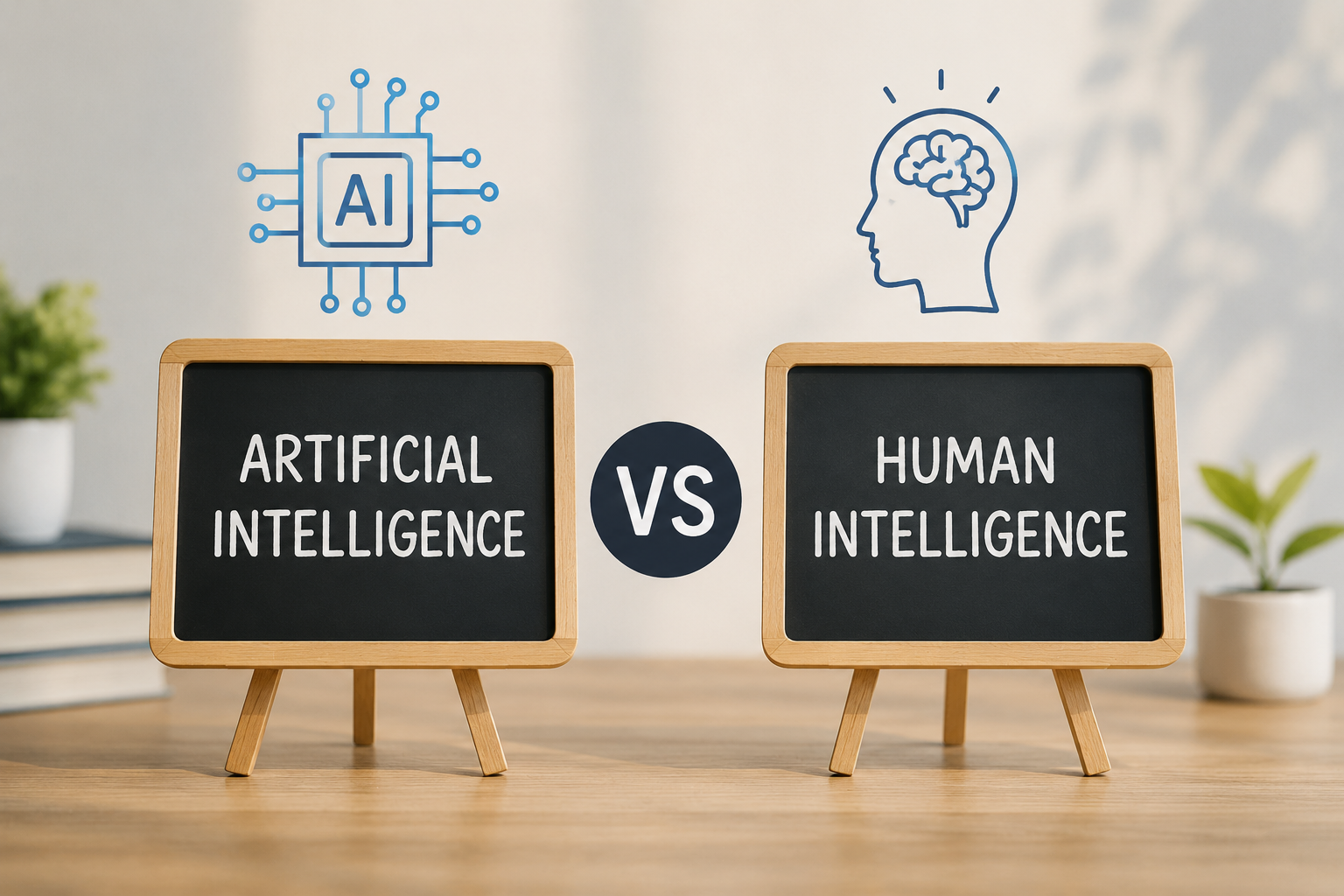
An artificial intelligence Vs human intelligence comparison for students highlights how modern education balances computational power with human logic. While artificial intelligence excels in processing large volumes of data, recognizing complex patterns, and offering rapid study support, human intelligence delivers emotional awareness, creative reasoning, and ethical judgment. In American classrooms, artificial intelligence functions best as a supportive tool rather than a substitute for personal effort. By understanding the key differences between algorithms and human cognition, students can use technology to enhance their learning while preserving their critical thinking skills.
Table of Contents
-
Introduction to AI vs Human Intelligence in American Education
-
Exploring Human and AI Capabilities in Student Learning
-
AI vs Human Intelligence: Adapting to American Educational Needs
-
The Impact of AI on Student Learning in the USA
-
Practical Guidelines: How Students Can Use AI Wisely
-
Conclusion
-
Frequently Asked Questions (FAQs)
Introduction to AI Vs Human Intelligence in American Education
In recent years, the role of AI in modern US classrooms has expanded rapidly. From high school study groups to university research labs, students regularly encounter software applications that organize schedules, summarize research papers, and solve mathematical equations. This widespread availability leads to an essential topic of discussion: what is the difference between AI and human intelligence for students?
To understand how AI is different from human intelligence, one must examine how each system processes information and approaches problem-solving. Human intelligence is rooted in organic brain development, personal experience, self-awareness, and emotional context. When a student reads a literature chapter, they comprehend subtle themes, empathy, and historical context through their living experiences.
In contrast, artificial intelligence operates strictly on statistical probability, machine learning models, and extensive training data. It predicts the most likely next word or code line based on mathematical patterns rather than genuine comprehension. Recognizing this core distinction allows students in the USA to view digital platforms as helpful study aids rather than definitive authorities on academic subjects.
Exploring Human and AI Capabilities in Student Learning
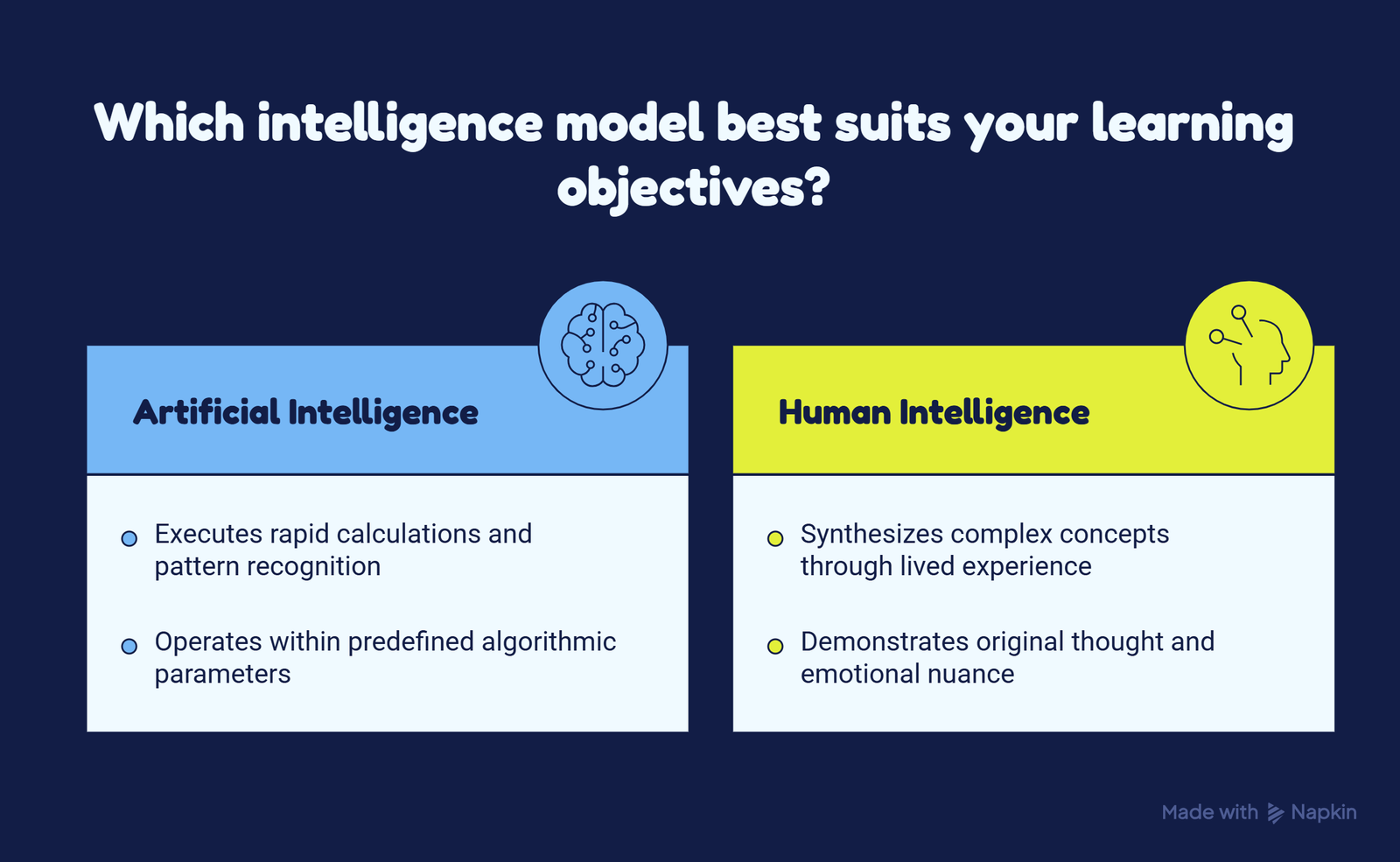
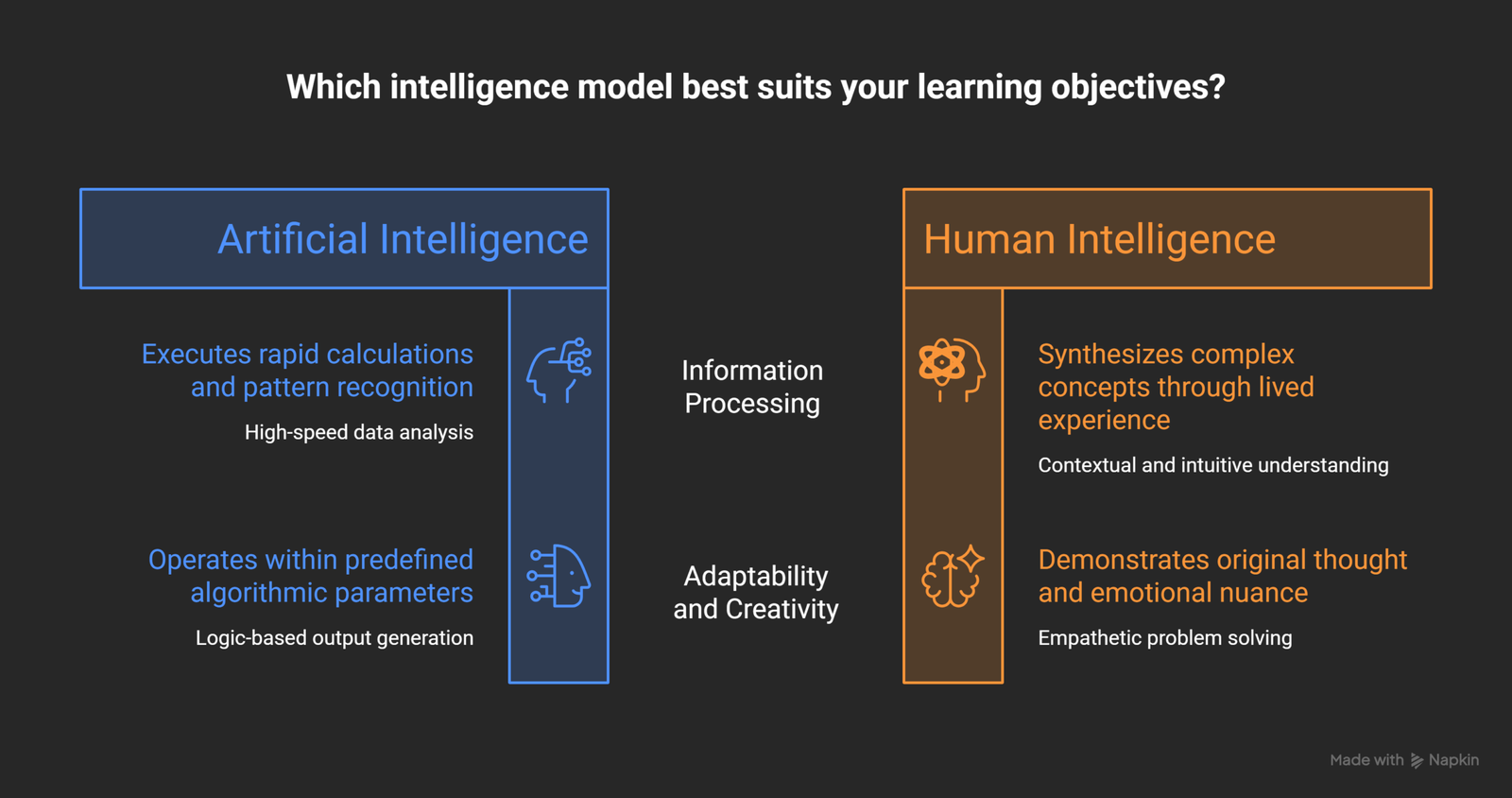
When comparing speed, scale, and pattern recognition in AI vs humans, digital systems demonstrate clear mechanical advantages. An algorithm can search through thousands of academic publications, locate specific statistics, and organize summary points in seconds.
What Can AI Do Better Than Humans?
Digital tools excel at processing repetitive tasks and managing structured data. Specific strengths include:
-
Sorting through large databases to identify specific text patterns.
-
Generating instant vocabulary exercises and practice quizzes based on uploaded notes.
-
Formatting bibliographies and citations across various style guidelines.
-
Providing continuous access to learning resources without time restrictions.
What Can Humans Do Better Than AI?
Despite computational advances, human intelligence possesses capabilities that algorithms cannot match:
-
Engaging in original creative thinking and developing novel hypotheses.
-
Understanding emotional nuance, tone, and cultural contexts in communication.
-
Applying ethical values and moral judgment to real-world problems.
-
Adapting to unfamiliar situations where existing reference data is absent.
Can AI think like a human? The short answer is no. While software can simulate conversational language, it lacks consciousness, self-reflection, and genuine understanding.
This leads to a common question: is AI smarter than human intelligence? Smartness in computers translates to processing speed and memory retrieval. Human smartness includes wisdom, emotional intelligence, and contextual awareness. While software can store more facts than a human mind, it cannot evaluate the ethical or societal relevance of those facts.
AI vs Human Intelligence: Adapting to American Educational Needs
As educational institutions across the United States adapt to new technologies, educators evaluate how AI and human intelligence complement each other in learning. Rather than viewing technology and human thought as competing forces, progressive classrooms combine both to enrich the learning environment.
Many parents and students ask: Can AI replace human intelligence in education? Or more specifically, will AI replace human intelligence in education in the future? Current research and practical evidence suggest that technology cannot substitute human cognition. True academic growth requires questioning assumptions, engaging in lively debate, and learning from mistakes. Software can organize information efficiently, but it cannot replace the curiosity that drives genuine discovery.
This raises another common question: can AI replace teachers? Teachers provide mentorship, motivation, behavioral guidance, and emotional encouragement. A software program cannot recognize when a student feels discouraged or needs extra motivation during a difficult lesson. This is why human intelligence is important for students. Human guidance fosters accountability and character development in ways software algorithms simply cannot replicate.
The Impact of AI on Student Learning in the USA
The growing presence of smart tools in academic settings raises important questions regarding student growth, academic integrity, and cognitive development.
Does AI Make Students Smarter?
The impact of digital assistance depends entirely on how individual learners choose to interact with it. Does AI make students smarter? If a student relies on software to write essays or generate direct answers without reviewing the underlying concepts, learning progress slows down. However, can AI improve student learning when used responsibly? Yes. When students use technology to test their understanding, clarify confusing concepts, or break down complex topics into smaller steps, comprehension improves.https://apkcad.com/top-10-best-ai-tools-for-students-in-2026/
Addressing Critical Thinking and Academic Integrity
A primary concern among educators is whether automated help reduces critical thinking skills. Does AI reduce critical thinking in students? It can, provided learners accept generated output uncritically without checking for logical gaps or factual errors.
Additionally, students often wonder: is using AI for schoolwork cheating? Using software to generate an entire paper or complete an online exam violates academic honor codes across US institutions. Conversely, using software to outline ideas, check grammar, or generate practice questions is generally recognized as a responsible study practice.
Looking ahead, the future of AI in creative education and emotional understanding will likely feature adaptive learning systems tailored to individual progress rates. However, when evaluating which is better, AI or human intelligence, the conclusion remains clear: human intelligence provides direction, ethics, and meaning, while artificial intelligence serves as a utility to support human achievement.
Practical Guidelines: How Students Can Use AI Wisely
To maintain academic rigor and build genuine knowledge, students should follow practical guidelines when incorporating digital tools into their routines:
-
Draft First, Assist Second: Complete initial essay outlines or problem sets independently before consulting digital tools for feedback.
-
Verify Factual Accuracy: Always cross-reference claims, statistics, and historical dates with reliable textbooks or peer-reviewed sources.
-
Focus on Concept Mastery: Ask software tools to explain the underlying logic of a solution rather than requesting final answers.
-
Engage in Active Learning: Use digital study tools to create flashcards or mock quizzes to test memory retention actively.
Conclusion
An artificial intelligence vs human intelligence comparison for students highlights a clear dynamic: digital tools bring speed, scale, and organization, while human minds provide purpose, creativity, and critical judgment. Students in the USA who learn to balance automated efficiency with personal effort will position themselves for long-term academic success. By treating technology as a supportive partner rather than a shortcut, learners can safeguard their critical thinking, excel in their studies, and prepare for a future driven by human ingenuity.
Frequently Asked Questions (FAQs)
What is the main difference between AI and human intelligence for students?
Human intelligence involves consciousness, emotional awareness, and critical reasoning. Artificial intelligence relies on statistical models and algorithms to process data quickly without true understanding.
Is AI smarter than human intelligence?
AI processes data faster and holds larger memory capacity, but human intelligence excels in creative reasoning, emotional understanding, adaptable problem-solving, and moral judgment.
Can AI replace teachers in US classrooms?
No. AI cannot replace teachers because it lacks emotional connection, adaptive mentorship, and the ability to inspire personal growth in students.
Does using AI for schoolwork reduce critical thinking?
Using AI can reduce critical thinking if accepted blindly. However, using it responsibly to test knowledge, format research, or review concepts strengthens learning habits.