
AI Flashcard Generator: 7 Genius Ways to Study 10x Faster
Quick Summary
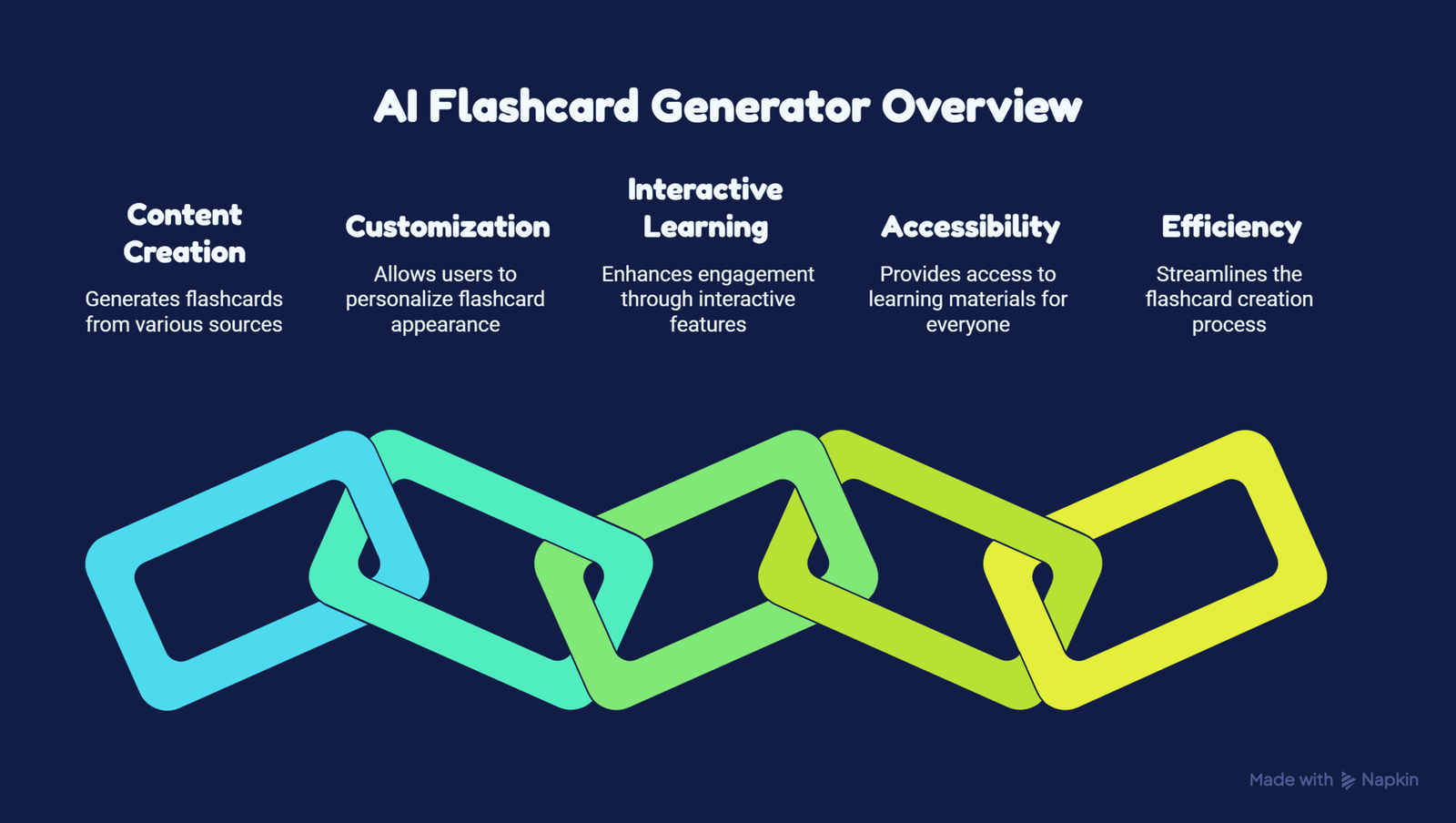
An AI flashcard generator automates the creation of study decks by transforming raw lecture notes, textbooks, and PDF documents into structured digital flashcards. Powered by natural language processing and machine learning algorithms, these tools extract key concepts, definitions, and question-answer pairs in seconds. By replacing manual card creation with automated workflows, students and professionals in the USA can focus their energy on active recall and spaced repetition. Understanding how AI flashcards work, their primary capabilities, accuracy considerations, and best practices ensures more efficient and reliable study routines.
Table of Contents
-
What is an AI Flashcard Generator?
-
Understanding the Technology Behind AI Flashcard Generators
-
How to Make Flashcards with AI Tools: Step-by-Step Process
-
Benefits and Capabilities of AI Flashcard Generation
-
Comparison: AI Flashcard Generators vs Traditional Tools
-
Limitations and Accuracy: Can AI Generate Accurate Flashcards?
-
Key Features of Popular AI Flashcard Generator Tools
-
Conclusion
-
Frequently Asked Questions (FAQs)
What is an AI Flashcard Generator?
Understanding AI flashcard generators starts with looking at how modern study habits are changing. Traditionally, creating flashcards required writing questions and answers by hand on index cards. An AI flashcard generator is intelligent study software that automates the entire process.
Instead of spending hours copying definitions, users simply upload their study materials. The software analyzes the text, identifies core ideas, and generates balanced flashcard decks automatically. Whether you are preparing for high school exams, medical board tests, or professional certifications, creating flashcards using AI reduces prep time while maintaining study consistency.
Understanding the Technology Behind AI Flashcard Generators
The underlying technology relies on modern computer science disciplines to make sense of unorganized text.
Natural Language Processing for Creating Flashcards
Natural language processing enables software to comprehend grammar, context, and semantic relationships within human language. When processing complex educational content, the software identifies subject-verb relationships, technical terms, and contextual explanations to structure meaningful question-answer pairs.
Machine Learning Algorithms in Flashcard Generation
Machine learning algorithms analyze vast datasets to determine how questions should be framed. These models learn to recognize key definitions, dates, formulas, and cause-and-effect relationships. Over time, algorithmic adjustments improve card clarity and relevance.
Data Inputs and Outputs in AI Flashcard Generation
The system processes various input formats, including digital textbooks, handwritten lecture notes, scanned PDFs, and web articles. The output consists of clean, formatted flashcard sets ready for review on computers or mobile devices.
How to Make Flashcards with AI Tools: Step-by-Step Process
Learning how to make flashcards with AI tools involves a simple, streamlined workflow.
Step-by-Step Process of AI Flashcard Generation
-
Prepare Your Source Material: Gather your lecture slides, class notes, or chapter outlines in a digital format.
-
Upload or Paste Content: Input your text into the generator platform.
-
Select Preferences: Choose parameters such as target card count, difficulty level, or question format (multiple choice, fill-in-the-blank, or standard Q&A).
-
Generate and Review: Allow the tool to process the data, then review the created cards for accuracy before saving.
Steps to Generate Flashcards from PDFs
Converting lengthy PDF readings into study decks is one of the most popular uses for this technology.
-
Upload your syllabus or chapter PDF directly into the platform interface.
-
Specify page ranges if you only need cards for a specific section.
-
Prompt the software to highlight definitions and summary points.
-
Export the finalized cards to your preferred flashcard app or study deck.
Generating Flashcards from Lecture Notes with AI
Using AI to convert notes into flashcards helps bridge the gap between classroom instruction and exam preparation. By uploading raw bullet points recorded during lectures, the system expands truncated sentences into complete, easy-to-understand study questions.
Converting Textbook Content into Flashcards with AI
Dense textbook chapters often contain overwhelming amounts of background detail. The software parses complex paragraphs, isolates foundational concepts, and transforms heavy reading assignments into bite-sized review cards.
Benefits and Capabilities of AI Flashcard Generation
Integrating AI-generated flashcards for enhanced studying offers measurable improvements in learning performance.
Improving Memory Retention with AI Flashcards
Effective learning relies on active recall and spaced repetition. By removing the physical friction of card creation, students can spend more time actually testing their memory. Spaced repetition algorithms built into digital platforms prompt users to review challenging cards right before forgetting occurs.
Capabilities of AI in Flashcard Generation
-
Rapid Processing: Converts multi-page documents into study sets in under a minute.
-
Contextual Adaptation: Formats questions based on subject matter, whether STEM, humanities, or language learning.
-
Multilingual Support: Translates and generates flashcards across multiple languages for language learners.
-
Custom Prompting: Allows users to adjust card depth from simple terminology checks to complex analytical questions.
Evaluating the effectiveness of AI-generated flashcards shows that students who use automated generation maintain higher review frequency because study preparation is no longer an obstacle.
Comparison: AI Flashcard Generators vs Traditional Tools
To appreciate the value of an AI flashcard generator, it helps to compare modern automated tools with traditional manual methods.
Limitations and Accuracy: Can AI Generate Accurate Flashcards?
While automated tools offer remarkable efficiency, understanding the limitations of autonomously generated flashcards by AI is critical for academic success.
Can AI Generate Accurate Flashcards?
In most cases, yes. Modern language models excel at factual extraction and summarizing explicitly stated information. However, accuracy depends heavily on the quality of the source material provided.
Limitations to Keep in Mind
-
Context Misinterpretations: If lecture notes contain fragmented or ambiguous sentences, the generator may misinterpret the intended meaning.
-
Hallucinations: In rare instances, models might insert extraneous facts not present in the original input.
-
Lack of Deep Reasoning: Automated generators are ideal for foundational concepts, definitions, and facts, but may struggle with highly abstract synthesis.
To ensure accuracy, always conduct a brief manual review of generated cards before starting intensive study sessions.
Key Features of Popular AI Flashcard Generator Tools
Selecting the right platform depends on your specific workflow preferences. Popular AI flashcard generator tools typically include the following key features:
-
Multi-Format Document Upload: Seamless support for PDF, DOCX, PPTX, and image files.
-
Integration Options: Ability to export study decks directly to platforms like Anki or Quizlet.
-
Adaptive Testing Modes: Multiple study options including flashcards, practice tests, and matching games.
-
Smart Summarization: Automatic extraction of key takeaways alongside generated questions.
Conclusion
Adopting an AI flashcard generator represents a major shift in modern study strategy. By shifting the heavy lifting of card creation from manual effort to automated software, students and lifelong learners can dedicate their valuable time to active recall and long-term retention. While human oversight remains important to verify accuracy, the speed, scale, and convenience of AI-driven flashcard tools make them indispensable for efficient learning.
Frequently Asked Questions (FAQs)
What is the best AI flashcard generator for students?
The best tool depends on your study materials. Tools that support direct PDF uploads, custom prompting, and export options to popular study platforms are generally recommended for high school and college students.
Can an AI flashcard generator convert handwritten notes?
Yes, many modern tools feature optical character recognition (OCR) technology, allowing them to scan legibly handwritten notes and convert them into digital study decks.
How does an AI flashcard generator improve study efficiency?
It saves hours of manual writing or typing, allowing you to spend almost all your study time on active recall, self-testing, and spaced repetition.
Is it safe to rely on AI-generated flashcards for major exams?
AI flashcards are highly effective, but you should always perform a quick review pass over your generated cards to verify that all terms, formulas, and historical facts match your official course material.