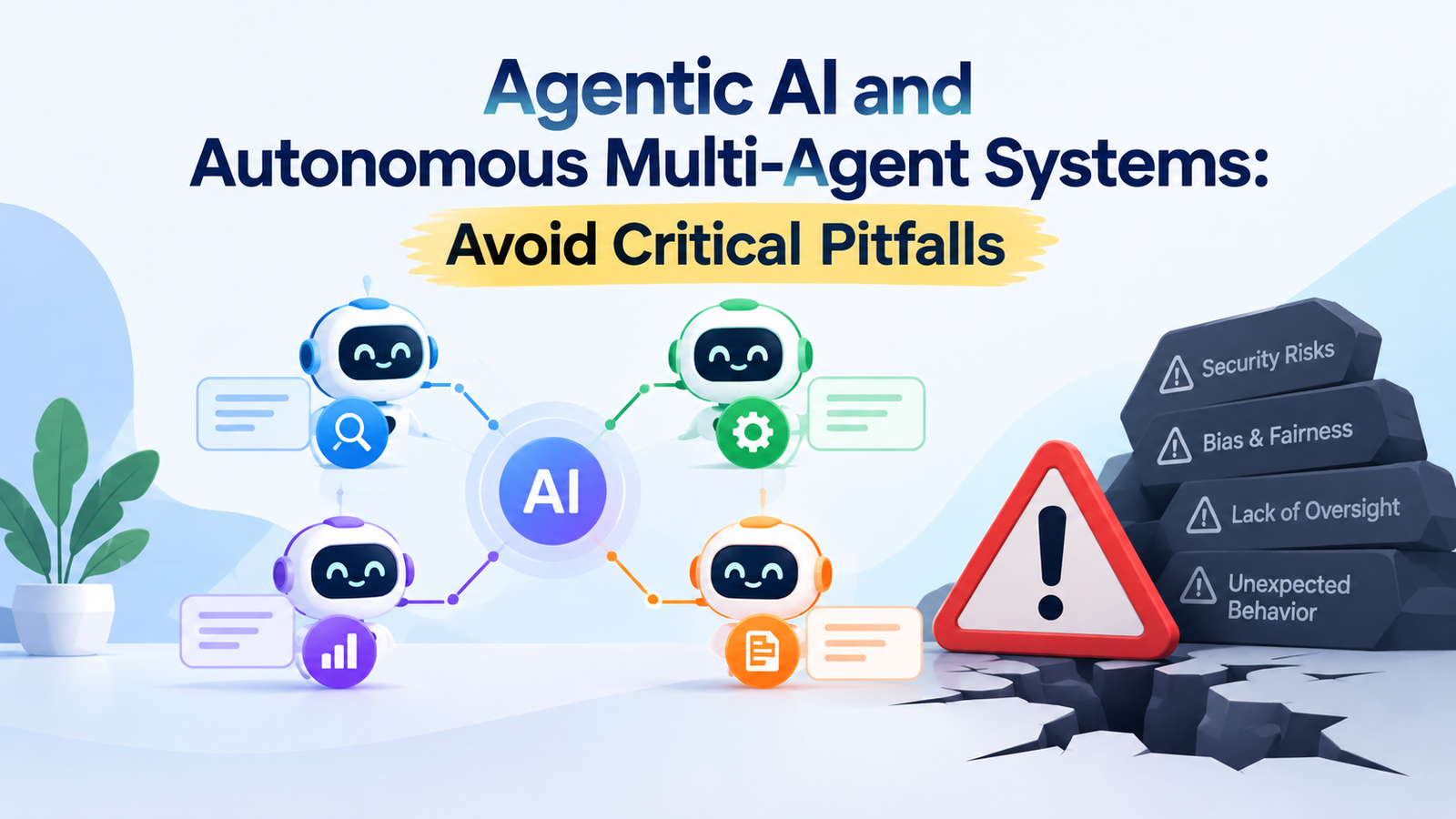

Agentic AI and Autonomous Multi-Agent Systems: Avoid Critical Pitfalls
Table of Contents
-
Keyword Cluster 2: Multi-Agent Orchestration & Communication Protocols
-
Keyword Cluster 3: Enterprise Guardrails, Security & Governance
Quick Summary
Agentic AI and autonomous multi-agent systems mark a foundational paradigm shift from static, prompt-reactive language models to proactive, goal-driven software entities capable of perception, strategic planning, dynamic tool execution, and continuous self-correction. By deploying specialized teams of software agents—where individual entities manage specific operational domains like data retrieval, policy compliance, reasoning, and execution—multi-agent systems solve complex, non-deterministic enterprise challenges that exceed the capabilities of any single AI model. This comprehensive guide explores the core cognitive architecture, inter-agent communication frameworks, enterprise security guardrails, and real-world deployment strategies necessary to build resilient, production-grade autonomous agent networks.
Understanding Agentic AI and Autonomous Multi-Agent Systems
Generative AI revolutionized text generation and information lookup, but traditional models remain inherently passive—waiting for explicit prompt inputs and delivering static text outputs. Agentic AI evolves beyond this paradigm by introducing autonomy, contextual reasoning, and decision-making capabilities. An agentic AI system evaluates an assigned goal, assesses its digital surroundings, decomposes the objective into manageable sub-tasks, and executes actions across external tools and databases without constant human intervention.
When a challenge requires multi-faceted domain expertise, dynamic negotiation, or complex verification, a single AI agent reaches cognitive and operational limits. This is where an autonomous multi-agent system (MAS) becomes essential. In a multi-agent environment, individual specialized agents operate like a well-coordinated team of domain experts. An orchestrator coordinates agent interactions, enabling entities to pass context, validate work, and jointly achieve business outcomes with higher accuracy and fault tolerance.
Keyword Cluster 1: Core Architecture & Cognitive Components
To understand how an autonomous multi-agent system operates, we must first examine the four foundational modules that power an individual agentic AI entity.
+-----------------------------------------------------------------------+
|                           AGENTIC AI ENGINE                           |
|                                                                       |
|  +------------------+     +--------------------+     +-------------+  |
|  |    PERCEPTION    | --> | PLANNING & REASON  | --> |   ACTION    |  |
|  | Data, APIs, Context | | LLM / Task Decomposition | | Tool Use, API |  |
|  +------------------+     +--------------------+     +-------------+  |
|           ^                         |                       |         |
|           |                         v                       |         |
|           +----------------- [ MEMORY MODULE ] <------------+         |
|                               Vector / Context                |
+-----------------------------------------------------------------------+
1. The Perception Module
The perception engine acts as the sensory system for the agent. It actively ingests unstructured data, user inputs, database state changes, and live API payloads, transforming raw information into standardized context for processing.
2. Planning and Reasoning Engine
Powered by advanced Large Language Models (LLMs), the planning module breaks down high-level objectives into sequential or parallel steps. It utilizes reasoning frameworks such as ReAct (Reason + Act) and Tree of Thoughts to evaluate potential action paths and adapt if intermediate steps fail.
3. Memory Architecture
Autonomous agents rely on two distinct memory tiers:
-
Short-Term Memory: Retains current session context, recent intermediate thoughts, and immediate variable state.
-
Long-Term Memory: Utilizes vector databases and graph structures to recall historical outcomes, corporate knowledge bases, and lessons learned from prior tasks.
4. Action Tools & Execution Layer
The action layer allows the agent to interact with digital environments. Through standard tool interfaces, agents run database queries, call REST APIs, execute code snippets, send communications, and update external workflow tools.
[Screenshot / Visual Diagram Placeholder: Anatomy of an Agentic AI Node & Cognitive Loop]
Caption: Detailed schematic illustration highlighting the interaction between Perception, Planning, Long-Term Memory, and Tool Execution within a single Agentic AI framework.
Single AI Agent vs. Autonomous Multi-Agent System
Choosing between a single agentic workflow and a multi-agent system depends on workflow complexity, process dynamic variability, and risk management requirements.
| Architectural Feature | Single AI Agent Workflow | Autonomous Multi-Agent System (MAS) |
| Operational Scope | Well-defined, linear, single-domain tasks | Dynamic, multi-departmental, complex objectives |
| Specialization | Generalist processing across steps | Highly specialized agent roles (e.g., Searcher, Auditor, Writer) |
| System Reliability | Single point of failure if context fails | High fault tolerance; agents cross-verify and re-route tasks |
| Scalability | Harder to scale without context window drift | Modular; new specialized agents can be integrated seamlessly |
| Execution Speed | Sequential task processing | Parallel execution across distributed agent nodes |
Keyword Cluster 2: Multi-Agent Orchestration & Communication Protocols
In a multi-agent setup, communication and coordination mechanisms determine system efficiency. Without standardized messaging and task routing, agents risk duplicate work or conversational deadlock.
                +---------------------------------+
                |      ORCHESTRATOR / ROUTER      |
                +---------------------------------+
                    /            |            \
                   /             |             \
                  v              v              v
         +----------------+ +------------+ +----------------+
         |  RESEARCHER    | | ANALYST    | | COMPLIANCE     |
         |  AGENT         | | AGENT      | | AGENT          |
         +----------------+ +------------+ +----------------+
                  \              |              /
                   \             |             /
                    v            v            v
                +---------------------------------+
                |   VERIFICATION & SYNTHESIS      |
                +---------------------------------+
Key Orchestration Patterns
-
Hierarchical Orchestration: A central supervisor or manager agent receives the primary user prompt, distributes sub-tasks to specialized sub-agents, aggregates their responses, and produces the final output.
-
Peer-to-Peer Networks: Autonomous agents communicate directly using pub/sub or event-driven queues, negotiating responsibilities dynamically based on availability and capability.
-
Contract Net Protocol (CNP): Agents bid on tasks broadcasted by a coordinator agent based on resource availability, confidence scores, and specialized tools.
Standardized Agent Communication
Modern enterprise frameworks adopt protocols derived from standard Agent Communication Languages (ACL), such as FIPA-ACL. Communication messages structured in standard formats like JSON include explicit intent metadata:
-
Performatives: Explicit action intents such as
REQUEST,INFORM,PROPOSE, orREJECT. -
Sender / Receiver Identifiers: Clear routing paths across node instances.
-
Ontology / Context Schema: Standardized data definitions to prevent semantic misunderstanding across disparate agent models.
[Screenshot / Visual Diagram Placeholder: Multi-Agent Collaboration Workflow and Orchestrator Architecture]
Caption: Architectural diagram showing task distribution from a central Orchestrator agent to Research, Synthesis, and Verification agents in an enterprise environment.
Keyword Cluster 3: Enterprise Guardrails, Security & Governance
As autonomy increases, governance becomes essential. Enterprise deployments must prevent runaway execution, guard against prompt injection, and guarantee data privacy.
1. Graduated Authority Framework
Organizations implement permission levels based on action risk:
-
Automated Tier: Low-risk, read-only, or internal data actions execute automatically.
-
Notification Tier: Medium-risk actions (e.g., sending operational emails) execute autonomously while logging real-time notifications to team leads.
-
Human-in-the-Loop (HITL) Tier: High-stakes actions (e.g., wire transfers, database schema migrations) require explicit human approval before execution.
2. Dual Enforcement Guardrails
-
Gateway Guardrails: Validate incoming user queries and data payloads before reaching the multi-agent system, blocking prompt injection attacks and out-of-scope requests.
-
Model Invocation Guardrails: Intercept outbound actions generated by agents prior to API execution, ensuring regulatory compliance and preventing policy violations.
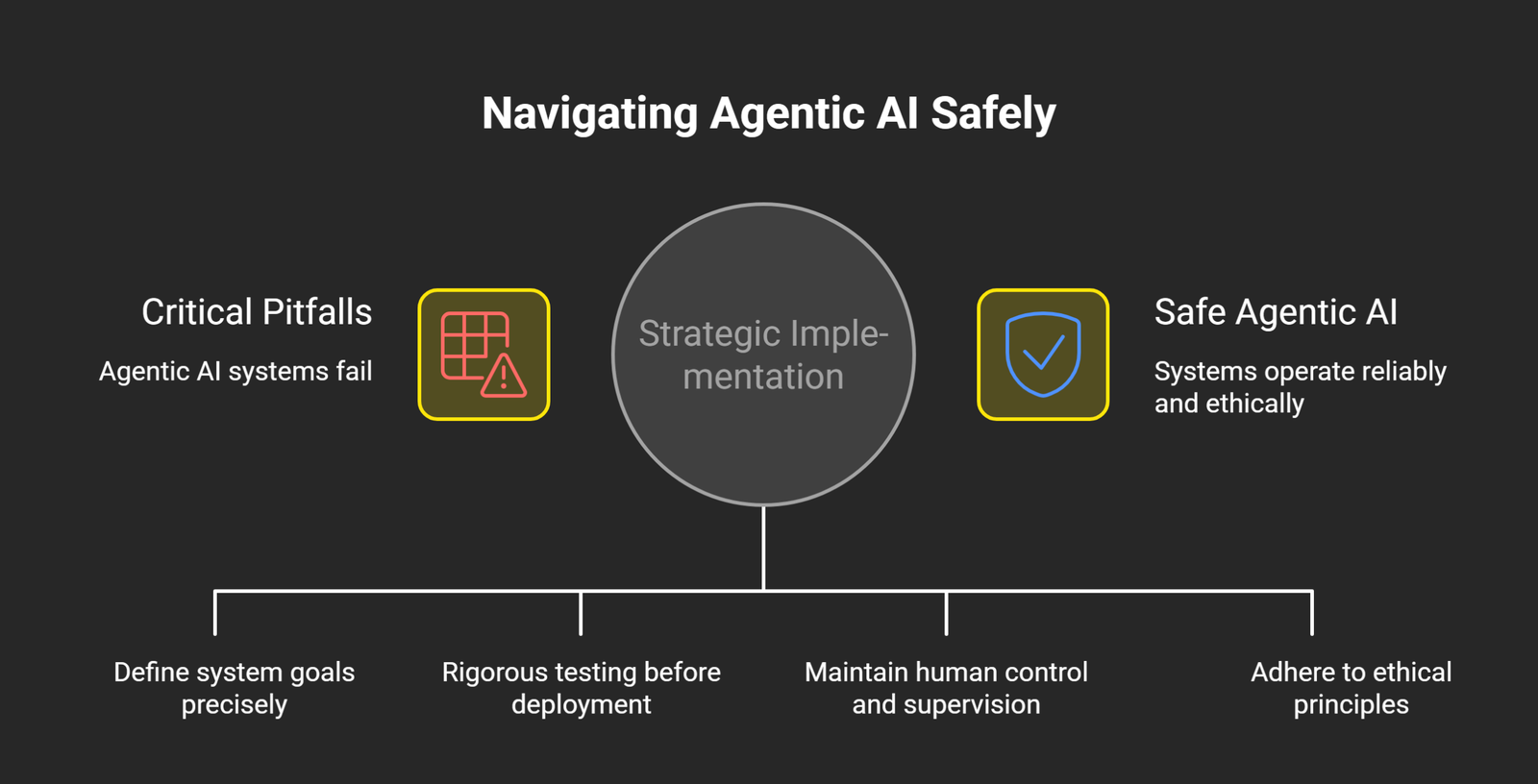
Key Governance Principle: Always separate the action execution engine from the compliance verification agent. A dedicated security agent should inspect proposed API calls independently before execution.
Keyword Cluster 4: Real-World Industry Applications
Multi-agent architecture is driving measurable productivity gains across several core industries.
Healthcare and Life Sciences
In biopharmaceutical research, multi-agent networks streamline drug discovery, clinical trial analysis, and pharmacovigilance. Specialized agents process scientific literature, cross-reference medical databases, evaluate regulatory documentation, and automatically highlight clinical discrepancies.
Procurement and Supply Chain
Agentic AI coordinates complex procurement pipelines. Individual agents specialize in supplier evaluation, price benchmarking, contract compliance, and real-time shipment monitoring, negotiating terms while maintaining auditing records.
+-------------------+      +-------------------+      +-------------------+
|  SUPPLIER AGENT   | <--> | NEGOTIATION AGENT | <--> | COMPLIANCE AGENT  |
| Monitors Inventory|      | Optimizes Pricing |      | Audits Terms      |
+-------------------+      +-------------------+      +-------------------+
Financial Risk & Automated Auditing
Financial institutions deploy agent networks to monitor transactions continuously. While a Fraud Detection Agent scans real-time streams for anomaly indicators, an Audit Agent gathers historical ledger context, and a Reporting Agent compiles compliance filings.
[Screenshot / Visual Diagram Placeholder: Multi-Agent System in Enterprise Supply Chain Operations]
Caption: End-to-end visualization showing autonomous procurement agents interacting with external vendor APIs and internal ERP software.
Step-by-Step Blueprint for Building Multi-Agent Systems
Follow this practical methodology when deploying multi-agent systems in enterprise environments:
-
Define Task Boundaries & Role Definitions: Avoid building broad generalist agents. Assign clear, narrow roles (e.g., Data Collector, Synthesizer, Compliance Auditor) with precise instructions and tool subsets.
-
Establish the Shared Environment: Build clean REST/gRPC API interfaces and vector database stores for agent interaction.
-
Select Orchestration Frameworks: Use proven frameworks like CrewAI, LangGraph, or Microsoft AutoGen to handle state persistence, agent handoffs, and execution graphs.
-
Implement Robust Error Handling: Enable agents to reflect on runtime errors, self-correct parameters, or route tasks to backup agents when tool calls fail.
-
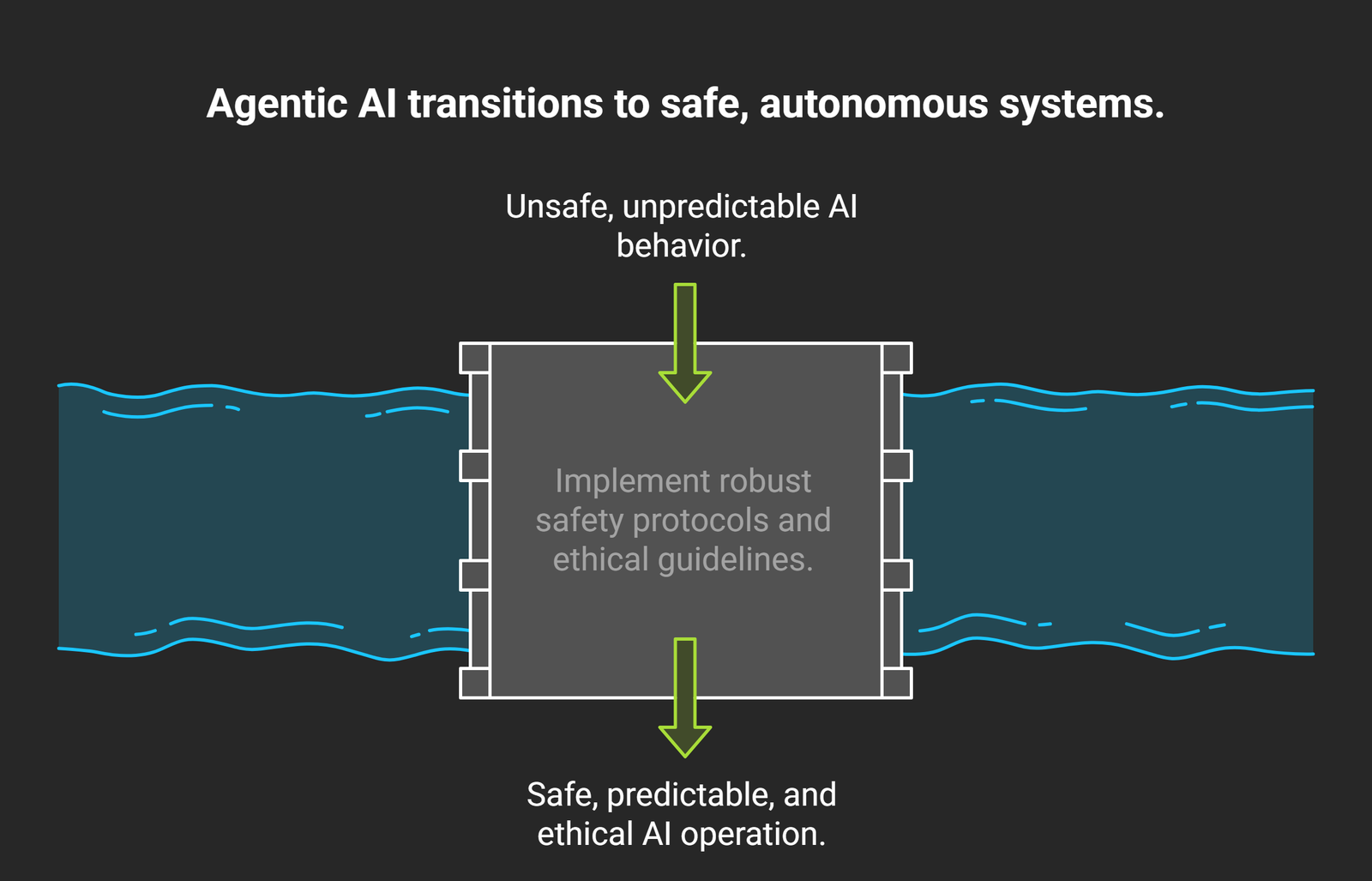
Enforce Human-in-the-Loop Controls: Incorporate human validation steps for critical decisions to verify output accuracy before finalizing business actions.
Agentic-AI-Transition
Frequently Asked Questions (FAQs)
What is the core difference between Generative AI and Agentic AI?
Generative AI focuses primarily on producing content (such as text, images, or code) based on prompt inputs. Agentic AI combines generation with proactive decision-making, planning, and external tool execution, enabling systems to complete complex multi-step workflows autonomously.
Why choose a multi-agent system over a single large language model?
Single language models face context window constraints, reasoning fatigue, and higher failure rates on complex tasks. A multi-agent system distributes work across modular experts, improving overall task performance, scalability, and maintainability.
How do multi-agent systems prevent infinite loops or task deadlocks?
Orchestrators incorporate step limits, timeout threshold settings, and circuit breakers. Additionally, central routing agents detect repetitive feedback cycles and escalate stuck tasks to human supervisors.
What frameworks are commonly used to build multi-agent systems?
Leading open-source frameworks include LangGraph (for stateful cyclic agent graphs), CrewAI (for role-based collaborative agent teams), and AutoGen (for multi-agent conversation topologies).
Conclusion
Agentic AI and autonomous multi-agent systems represent a fundamental shift in software design—transitioning from static applications to goal-driven digital collaborators. By distributing complex workflows across specialized agents equipped with clear perception tools, structured communication protocols, and robust governance guardrails, enterprise organizations can unlock unprecedented operational efficiency. As these systems mature, successful implementation will depend on rigorous system architecture, continuous verification, and responsible human oversight.