Artificial intelligence is changing the way students learn, study, write, and prepare for exams. From high school classrooms to American universities, AI chatbots such as ChatGPT, Google Gemini, Claude, and Microsoft Copilot have become useful tools for answering questions, explaining difficult subjects, and organizing study materials. However, their growing presence also raises important questions about academic honesty, independent thinking, privacy, and the future of education.
Are AI Chatbots Helping or Hurting Students in the USA? The Shocking Truth is that these tools can support learning, but their impact depends on how students use them. An AI chatbot can act like a personal tutor by explaining concepts and testing a student’s understanding. The same tool can become a problem when a student copies answers without learning the material.
For American students, parents, teachers, and college instructors, understanding both sides is essential. This guide explores the benefits and risks of AI chatbots in education, what recent research reveals, and how students can use AI responsibly without sacrificing critical thinking and creativity.
Quick Summary
AI chatbots can help students in the USA understand difficult topics, prepare for exams, improve writing, brainstorm ideas, practice coding, and receive feedback at any time. However, they can also provide inaccurate information, generate unreliable references, create academic integrity problems, and encourage students to depend on technology instead of developing their own skills. The best approach is to use AI as a study assistant rather than a replacement for independent work. Students should verify important information, follow their school’s AI policy, protect their personal data, and practice what they learn without assistance. When used thoughtfully, AI can support education; when used carelessly, it can weaken the learning process.
Table of Contents
- How Common Are AI Chatbots Among U.S. Students?
- How AI Chatbots Are Helping Students in the USA
- The Risks of AI Chatbots in Education
- AI Chatbots: Helpful or Hazardous?
- How AI Chatbots Affect Critical Thinking and Creativity
- Are AI Chatbots Safe for School Assignments?
- How Students Can Use AI Chatbots Responsibly
- Which AI Chatbots Are Useful for American Students?
- The Role of Teachers, Parents, and U.S. Schools
- Frequently Asked Questions
- Conclusion
How Common Are AI Chatbots Among U.S. Students?
AI chatbots are no longer just experimental technology. Many American teenagers already use them to search for information, complete schoolwork, and understand unfamiliar subjects.
According to Pew Research Center’s February 2026 report on how teens use and view AI, 54% of U.S. teens ages 13–17 said they had used chatbots to get help with schoolwork. The survey also found that 57% had used chatbots to search for information. About one in ten said chatbots helped with all or most of their schoolwork.
Another report, Teens in the AI Era: Schoolwork and Skills That Matter, published by Common Sense Media in August 2026, reported that 70% of surveyed U.S. teens used AI for schoolwork. The research also found that students recognized both the advantages of AI and the risk of missing out on learning when they relied on it to finish assignments.
These findings show that AI-assisted learning deserves serious attention. They do not, by themselves, prove that chatbots improve grades or damage academic performance. To evaluate their educational impact, we must examine how students use these tools and whether they actually understand what they learn.
How AI Chatbots Are Helping Students in the USA
AI chatbots for students in the USA can provide several forms of academic support. Their usefulness becomes clearer when students use them to practice, understand, and improve their work instead of asking them to do everything.
1. Personalized Learning and Virtual Tutoring
One important benefit of AI chatbots is their ability to explain concepts in different ways. A student who struggles with an algebra equation, a biology concept, or a historical event can request a simpler explanation, an example, or a step-by-step demonstration.
Unlike a fixed study guide, a chatbot can respond to follow-up questions. Students can ask it to explain a confusing step, create another example, or test their understanding before moving to a new topic.
For example, a student studying quadratic equations could ask:
“Explain quadratic equations in simple language, demonstrate one example, and then give me three practice problems without showing their answers.”
This method encourages active participation. The student remains responsible for solving the problems and identifying areas that need more practice.
AI tutoring can be particularly useful when students need extra explanations outside classroom hours. However, it should complement teachers and qualified tutors rather than replace them entirely.
2. Exam Preparation and Revision
Preparing for exams requires more than reading notes repeatedly. Students need to recall information, apply concepts, identify weaknesses, and practice under different conditions.
AI chatbots can support this process by generating:
- Practice quizzes and multiple-choice questions.
- Flashcards for important terms and definitions.
- Mock exam questions based on a study outline.
- Revision schedules for upcoming tests.
- Explanations of incorrect answers.
A college student preparing for a psychology examination, for example, can ask a chatbot to produce a short practice test about memory, learning theories, and human behavior.
After answering the questions independently, the student can request explanations of the concepts they misunderstood.
The important distinction is that a quiz should test the student’s knowledge, not simply repeat information the student has already read.
3. Writing Assistance and Essay Development
Academic writing can be challenging for high school students and college students alike. Students must develop arguments, organize ideas, use suitable evidence, and communicate clearly.
AI writing assistance can help with brainstorming, outlining, grammar, sentence clarity, and feedback on a student’s own draft.
For example, a student writing a history essay could ask a chatbot to review the structure of an argument and identify points that need stronger evidence. The student can then revise the essay using course materials and reliable sources.
However, writing assistance should not become automatic essay generation. Students need to develop their own arguments and voices, and they must follow their instructors’ rules about AI-generated text, editing, and disclosure.
4. Research and Information Discovery
AI chatbots can help students understand research topics, identify useful search terms, compare concepts, and prepare questions for further investigation.
A student researching renewable energy might ask an AI tool to explain the differences between solar, wind, and geothermal power. That explanation can provide a starting point for more detailed research.
The student should then consult credible publications, original research, government websites, or academic databases to verify important claims.
AI-generated citations require particular care. A reference that looks academic may contain an incorrect title, author, publication date, or nonexistent source. Students should open the original source and confirm that it supports the claim before citing it.
AI is best used as a starting point for research rather than a substitute for reading and evaluating evidence.
5. Coding and Technical Problem-Solving
Students studying computer science, data science, and other technical subjects can use AI chatbots to understand programming concepts, identify errors, and compare different approaches to a problem.
For example, a beginner who receives a Python error can ask the chatbot to explain what the message means, identify possible causes, and suggest a debugging exercise.
This can make programming easier to approach, particularly when students are learning unfamiliar syntax.
Nevertheless, generated code must be tested and understood. Copying a solution without knowing how it works may help a student finish one assignment but leave them unprepared for the next project or examination.
6. Language, Accessibility, and Learning Support
AI tools can rephrase complex instructions, explain vocabulary, summarize reading material, and support students who need additional help understanding academic language.
These features may benefit students who are learning English or who find certain texts difficult to understand. Some AI platforms also offer voice, image, or document-based interactions, depending on the product and available plan.
Accessibility benefits vary by tool, student, and task. AI chatbots should not be assumed to replace professional accommodations, assistive technology, or specialized educational support.
The Risks of AI Chatbots in Education
The benefits of AI chatbots are meaningful, but the dangers deserve equal attention. The major concern is not simply that students use AI. It is that they may trust it too much or use it to avoid the work required for learning.
1. Reduced Critical Thinking and Independent Learning
Critical thinking develops when students examine evidence, ask questions, compare explanations, make decisions, and work through uncertainty.
If an AI chatbot provides an immediate answer every time a problem becomes difficult, students may lose opportunities to practice these skills.
Consider two students preparing for a chemistry examination. One student asks AI to explain a reaction, solves practice questions, and checks mistakes. The second copies every answer into a notebook without understanding the reasoning.
Both students have used AI, but their learning experiences are different.
The first uses technology to strengthen understanding. The second risks confusing completed work with actual knowledge.
This is why concerns about AI dependence and student learning outcomes should focus on the way a chatbot is used rather than simply counting how often students open one.
2. Incorrect Answers and False Confidence
AI chatbots can produce responses that sound convincing even when they are incorrect. They may misunderstand a question, make a calculation error, omit important context, or present outdated information.
This creates a problem for students who assume that a confident answer must be correct.
A chatbot might explain a scientific concept inaccurately or provide a historical statement without sufficient evidence. If the student copies the answer into an assignment, the mistake can spread into their academic work.
Students should verify important claims against authoritative sources and treat AI responses as suggestions that require evaluation.
3. Cheating and Academic Integrity Problems
Is using ChatGPT for homework considered cheating in the USA? The answer depends on the assignment, instructor, and institution.
Some teachers permit AI for brainstorming or feedback but prohibit AI-generated final answers. Others may allow broader use when students disclose how the tool contributed. Certain examinations and assignments may prohibit AI assistance entirely.
Submitting generated work as one’s own can violate academic integrity rules and interfere with the purpose of an assignment.
Students should check their course syllabus and ask their instructor when the rules are unclear. They should also disclose AI assistance when required and make sure they can explain and defend the work they submit.
The responsible approach is not to assume that all AI use is cheating or that all AI use is allowed.
4. Privacy and Student Data Security
AI chatbots may process the information users enter into prompts, uploaded documents, or conversations. The way that information is handled depends on the service, account settings, product terms, and applicable policies.
Students should avoid sharing passwords, student identification numbers, private educational records, sensitive personal details, or confidential documents unless the use is specifically authorized and appropriate safeguards are in place.
The U.S. Department of Education provides guidance on student privacy and educational technology, including concerns about sharing information through digital services.
Students should review the privacy settings and terms of the AI tool they use. Schools should also evaluate the privacy and security implications of educational technology rather than assuming every chatbot is appropriate for classroom use.
5. Bias and Unequal Access
AI chatbots can produce biased or incomplete responses because their outputs depend on their training, design, and the information available to them.
A student researching a historical event, social issue, or public policy should compare perspectives and investigate the supporting evidence instead of treating one chatbot’s answer as the final truth.
Access is another concern. Students may have different devices, internet connections, paid subscriptions, or school-provided resources. These differences can affect which tools and features are available to them.
Schools should consider these differences when creating AI policies and designing assignments. Students should not be unfairly disadvantaged because they lack access to a particular AI platform.
6. Overdependence on Automated Answers
AI chatbots can make studying feel faster because they can produce summaries, essays, explanations, and answers quickly.
However, efficiency is not the same as learning.
A student who regularly avoids reading, writing, calculating, or developing an argument independently may struggle when asked to perform those tasks without assistance.
Overdependence can also reduce opportunities for students to discuss ideas with classmates, receive human feedback, and learn from mistakes.
A balanced study routine includes both AI-assisted practice and time spent working independently.
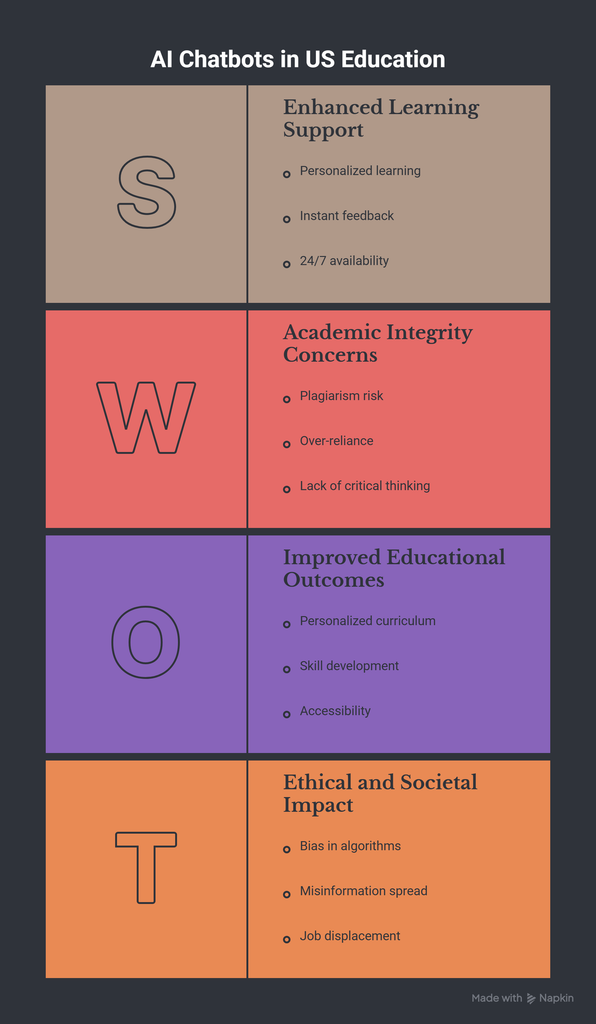
AI Chatbots: Helpful or Hazardous?
The impact of AI chatbots in education becomes clearer when we compare responsible use with overreliance.
| Study activity | Helpful use | Risky use |
|---|---|---|
| Homework | Ask for hints and explanations | Copy final answers without understanding |
| Exam preparation | Generate practice questions | Memorize unverified information |
| Essay writing | Improve your own draft | Submit generated work against course rules |
| Research | Explore topics and verify sources | Trust invented or incorrect citations |
| Mathematics | Learn each step of a solution | Skip practice and copy calculations |
| Coding | Understand and test suggested code | Submit code that you cannot explain |
| Creativity | Explore alternatives and develop ideas | Let AI make every creative decision |
| Privacy | Review settings and avoid sensitive data | Upload confidential student information |
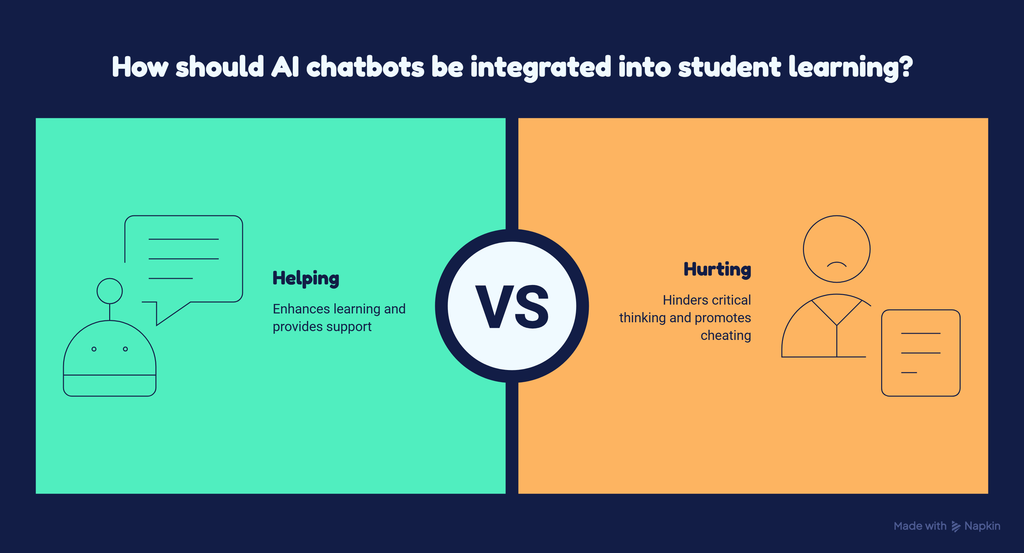
AI chatbots are helpful when they support a student’s effort to understand, practice, and improve. They become hazardous when students use them to avoid learning, accept inaccurate answers, or ignore academic and privacy requirements.
The same tool can produce either outcome, depending on how it is used.
How AI Chatbots Affect Critical Thinking and Creativity
One of the most important questions in AI education is whether chatbots strengthen students’ thinking or replace it.
The answer depends on the learning activity. Asking a chatbot to challenge an argument or explain an alternative solution can encourage deeper analysis. Asking it to write an entire argument before the student has considered the subject can limit the student’s opportunity to develop original ideas.
Students can protect their independent thinking by following a simple sequence:
Think first, use AI second, and evaluate the result third.
First, students should attempt a problem or write down their initial ideas. Next, they can use AI to identify gaps, explain difficult concepts, or suggest different perspectives. Finally, they should assess the response, verify important facts, and complete a similar task without AI.
Creative work requires the same care. AI may suggest story ideas, design concepts, or project outlines, but students should make meaningful decisions about the final result.
Human judgment, curiosity, originality, and the ability to explain one’s reasoning remain important educational skills.
Are AI Chatbots Safe for School Assignments?
AI chatbots can be useful for school assignments, but safety involves more than receiving an answer without an obvious error.
Students should consider three questions before using a chatbot for academic work.
First, is the use permitted? Check whether the teacher allows AI for brainstorming, research, writing feedback, coding, or the specific assignment in question.
Second, is the information reliable? Verify factual claims, calculations, quotations, and academic references. Do not assume that a response is accurate simply because it is well written.
Third, does the work reflect your learning? Students should be able to explain the ideas, methods, and conclusions in their submitted work. If they cannot explain the answer without the chatbot, they may need more practice.
Privacy also matters. Avoid uploading personal records or confidential material to an unapproved platform.
Responsible AI use combines academic integrity, fact-checking, privacy awareness, and independent understanding.
How Students Can Use AI Chatbots Responsibly
Students do not need to choose between using AI for everything and avoiding it completely. A more effective approach is to use chatbots for specific learning goals and maintain responsibility for the final work.
A Practical AI Study Method
Step 1: Attempt the task yourself. Read the question, review your notes, and make an initial effort before seeking assistance.
Step 2: Ask for an explanation. Request step-by-step guidance, examples, or hints rather than an immediate final answer.
Step 3: Check the evidence. Verify important facts and references using course materials, trusted publications, or original sources.
Step 4: Practice independently. Complete a similar question without AI to confirm that you understand the underlying concept.
Step 5: Follow course rules. Check the instructor’s AI policy and disclose or cite AI assistance when required.
Step 6: Protect your privacy. Use appropriate settings and avoid sharing sensitive information unnecessarily.
Better Prompts for Learning
The wording of a prompt can influence whether a student receives a useful learning experience.
Instead of asking, “Write my entire biology assignment,” students can ask:
“Teach me the main stages of cellular respiration in simple language. Give me one example, then ask five questions to test my understanding. Do not reveal the answers until I respond.”
Instead of asking, “Solve this math problem for me,” students can ask:
“Help me understand the method for solving this equation. Give me the first hint, let me attempt the next step, and explain any mistake I make.”
For research, a student might ask:
“Help me identify the main research questions about renewable energy. Suggest reliable types of sources to investigate, and clearly distinguish established facts from claims that need verification.”
These prompts encourage interaction rather than passive copying. The student remains involved in reasoning, evaluation, and decision-making.
Which AI Chatbots Are Useful for American Students?
Several AI chatbots can support studying, writing, research, and technical learning. No single platform is best for every student or every assignment.
ChatGPT
ChatGPT can help explain concepts, generate practice questions, brainstorm essay topics, review drafts, and discuss problem-solving approaches. Students should verify factual claims and make sure their use complies with course rules.
Google Gemini
Google Gemini can support learning through explanations, idea development, research exploration, and compatible Google ecosystem features. Students should verify claims and check the availability of specific features.
Claude
Claude can assist with discussing readings, organizing arguments, examining documents, and reviewing writing. Students should confirm important details against the original material.
Microsoft Copilot
Microsoft Copilot can help with general questions, study tasks, and supported Microsoft productivity workflows. Available capabilities depend on the version and account.
Perplexity
Perplexity can help students explore a topic and find sources to investigate further. Students should still open the linked sources, evaluate their reliability, and make sure the sources support the claims being made.
When choosing an AI study chatbot, students should consider the learning task, answer quality, source transparency, privacy settings, accessibility, cost, and school policies.
These tools can assist with academic work, but none should be treated as an unquestionable authority. Product features and subscription terms may change, so students should check current information before relying on a particular capability.
The Role of Teachers, Parents, and U.S. Schools
The discussion about AI chatbots should not place all responsibility on students. Teachers, parents, schools, and technology providers also have important roles in promoting safe and effective use.
Clear AI Policies in Schools
Schools and universities should explain which AI activities are allowed, restricted, or prohibited. Students need clear instructions about whether they can use chatbots for brainstorming, drafting, editing, programming, and research.
Policies should also clarify how students must acknowledge AI assistance and what happens when academic rules are violated.
Because requirements can differ by institution, course, and assignment, students should not assume that one school’s policy applies everywhere in the United States.
Teaching AI Literacy
AI literacy means understanding how AI tools work at a practical level, recognizing their limitations, checking their outputs, and using them responsibly.
Students should learn that a chatbot generates responses that may be useful but can still contain errors or bias. They should know how to verify information, protect personal data, and recognize when human judgment is necessary.
The UNESCO guidance on generative AI in education and research emphasizes a human-centered approach, including privacy protection, appropriate safeguards, and meaningful educational use.
AI literacy should be part of learning how to evaluate information, not just learning how to write better prompts.
Maintaining Human Support
Teachers provide more than explanations. They understand classroom context, assess student progress, encourage discussion, and help students develop social and academic skills.
Parents can support responsible use by discussing AI openly, asking students to explain what they learned, and encouraging independent problem-solving.
Schools should assess not only whether students can produce an answer but also whether they understand the concepts and can apply their knowledge without assistance.
A balanced approach combines useful technology with human feedback, clear expectations, and opportunities for independent work.
Frequently Asked Questions
1. Are AI chatbots helping or hurting students in the USA?
AI chatbots can help students understand difficult topics, practice exam questions, organize research, and receive writing feedback. They can also create risks when students rely on incorrect answers, copy assignments, or avoid independent thinking. Their impact depends on how the tools are used and the quality of the learning process.
2. What are the main benefits of AI chatbots for American students?
The main benefits include personalized explanations, practice quizzes, study planning, brainstorming, writing feedback, coding assistance, and support with unfamiliar subjects. Chatbots can also provide extra explanations outside classroom hours, although they do not replace qualified teachers or specialized support.
3. What are the biggest dangers of AI chatbots in education?
The major concerns include inaccurate information, fabricated citations, academic misconduct, privacy risks, bias, and overdependence. Students may also miss opportunities to develop critical thinking and problem-solving skills when they allow AI to complete work they need to learn themselves.
4. Can AI chatbots improve students’ grades?
AI chatbots may help students prepare more effectively when they use them to understand concepts, practice questions, and correct mistakes. However, using a chatbot does not automatically improve grades. Results depend on the student’s effort, the accuracy of the assistance, the subject, and how learning is assessed.
5. Do AI chatbots reduce critical thinking skills?
They can limit opportunities for critical thinking when students routinely accept generated answers without evaluating them. They can also support critical thinking when students use them to compare arguments, question assumptions, and analyze alternative solutions. The way the student engages with the tool matters.
6. Is using ChatGPT for homework considered cheating in the USA?
Not necessarily. The answer depends on the instructor’s rules, the institution’s academic integrity policy, and the type of assignment. Brainstorming or permitted feedback may be acceptable, while submitting prohibited AI-generated answers as one’s own can constitute misconduct. Students should check their course requirements.
7. How can U.S. schools regulate AI chatbot use?
Schools can establish clear rules for permitted and prohibited uses, explain disclosure requirements, teach AI literacy, protect student information, and design assessments that test actual understanding. Local policies and classroom requirements vary, so students should follow the rules set by their own school or instructor.
8. Can AI chatbots provide accurate answers for school assignments?
They can provide useful and accurate explanations, but they can also generate errors, incomplete responses, or false references. Students should verify important claims against course materials, textbooks, authoritative websites, and original research before using them in an assignment.
9. Are AI chatbots safe for high school students?
They can be useful when students receive appropriate guidance and use tools with suitable privacy and safety settings. Students should follow age requirements, school policies, and platform terms. They should also avoid sharing sensitive information and seek help from a teacher or trusted adult when needed.
10. How can students avoid becoming dependent on AI chatbots?
Students can attempt tasks before using AI, request hints rather than final answers, complete independent practice, and explain concepts in their own words. They should also spend time reading original materials, writing independently, and discussing ideas with teachers and classmates.
11. Can AI chatbots replace teachers and human tutors?
AI chatbots can provide additional explanations and practice, but they do not fully replace the judgment, personal understanding, classroom guidance, and human relationships provided by teachers and tutors. AI is best used to complement human support.
12. Which AI chatbot is best for students in the USA?
The best choice depends on the task, available features, privacy requirements, accessibility, cost, and school policies. Students may compare ChatGPT, Gemini, Claude, Copilot, and Perplexity for different study needs. They should verify answers regardless of which chatbot they choose.
13. Do AI chatbots put student privacy at risk?
They can create privacy risks if students share sensitive information without understanding how a service handles data. Students should review privacy settings and terms, avoid unnecessary disclosure of personal information, and use school-approved tools when required.
14. What is the most ethical way to use AI for school assignments?
Use AI only in ways permitted by the instructor, acknowledge its contribution when required, verify information, protect private data, and make sure the submitted work reflects your own understanding. Never assume that AI use is automatically permitted or prohibited for every assignment.
15. Will AI chatbots improve or damage the future of education?
AI chatbots may expand access to explanations and practice, but they can also create challenges involving academic integrity, privacy, accuracy, and independent thinking. Their long-term effect will depend on how schools, technology providers, and students integrate them into teaching and learning.
Conclusion
Are AI chatbots helping or hurting students in the USA? The evidence points to a more complex answer than a simple yes or no.
AI chatbots can make studying more flexible by explaining difficult concepts, generating practice questions, assisting with research, and providing feedback. These benefits can be valuable for high school students, college students, and learners who need additional explanations outside the classroom.
At the same time, AI is not a substitute for the mental effort required to learn. Incorrect answers, fabricated references, privacy concerns, academic integrity violations, and excessive reliance can undermine the very skills education is intended to develop.
The most effective approach is to use AI as a partner in the learning process rather than a machine that completes every assignment. Students should think independently, verify claims, practice without assistance, and follow their schools’ rules. Teachers and parents should help students develop AI literacy and make responsible decisions.
For students in the USA, the goal is not simply to use more AI or avoid it altogether. It is to learn how to use AI thoughtfully while preserving the curiosity, judgment, creativity, and independent thinking that make education meaningful.