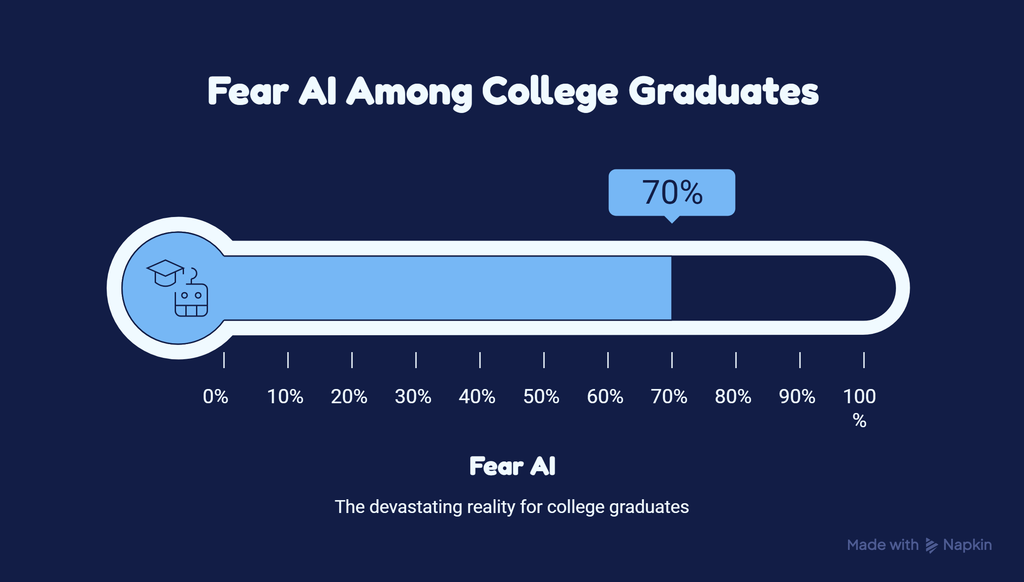
As artificial intelligence rapidly transforms the modern workforce, a wave of anxiety is sweeping across higher education institutions in the United States. Recent academic data and industry surveys reveal a sobering statistic: around 70% of college students view AI as a potential threat to future job prospects, particularly in coding, statistical analysis, and creative industries. While universities often champion AI as a revolutionary educational tool, the students sitting in lecture halls are increasingly worried about what graduation day actually looks like in an automated economy.
Quick Summary
The widespread integration of generative artificial intelligence into the professional world has sparked significant career anxiety among American college students. With roughly 70% expressing apprehension about their post-graduation employability, concerns are especially acute in technical fields like software development and data analysis, as well as creative domains like design and writing. Navigating this shift requires understanding where the real threats lie, adapting institutional curricula, and leveraging AI as a collaborative partner rather than viewing it purely as a replacement.
Table of Contents
- The Current State of Student Anxiety Around AI
- Why Technical and Creative Fields Are Feeling the Pressure
- Coding and Software Engineering
- Statistical Analysis and Data Science
- Creative Industries and Content Creation
- Bridging the Gap: How Universities and Students Are Responding
- Frequently Asked Questions (FAQs)
- Conclusion
The Current State of Student Anxiety Around AI
For generations, earning a college degree—especially from an institution in the U.S.—was viewed as a secure golden ticket to a stable career. Today, undergraduates face a very different reality. Tools capable of writing complex Python scripts, generating market research reports, and producing commercial artwork in seconds have fundamentally changed entry-level expectations.
Students are left wondering: If an AI can execute entry-level tasks in minutes, what value does a junior employee bring to an enterprise? This uncertainty is driving profound shifts in student mental health, major selection, and career planning.
Why Technical and Creative Fields Are Feeling the Pressure
While automation impacts nearly every sector, the anxiety is concentrated in specific domains where generative models have shown exponential capability.
Coding and Software Engineering
Computer science majors used to enjoy some of the highest employment and starting salary rates upon graduation. However, the rise of advanced AI coding assistants has changed how software is written. Because models can generate, debug, and optimize code efficiently, entry-level coding roles are evolving, leading students to question whether traditional programming skills alone will sustain a career.
Statistical Analysis and Data Science
Data-driven decision-making is core to modern business, but AI algorithms can now ingest massive datasets, clean data, run complex regressions, and visualize trends instantaneously. Aspiring data analysts worry that the heavy lifting of statistical analysis is being absorbed entirely by automated systems.
Creative Industries and Content Creation
Writers, graphic designers, filmmakers, and marketers face immediate disruption. Text-to-image generators and advanced language models have democratized content creation, lowering the barrier to entry and causing graphic design and copywriting students to fear a saturated, low-paying job market.
Bridging the Gap: How Universities and Students Are Responding
To counter these fears, U.S. higher education is transforming. Rather than banning or ignoring AI, forward-thinking institutions are integrating AI literacy directly into coursework. Students are learning to pivot from being mere executors of technical tasks to becoming system orchestrators—individuals who direct, critique, and refine AI outputs. Soft skills, critical thinking, and emotional intelligence remain a powerful defense against automation.
Frequently Asked Questions (FAQs)
1. Is an American college degree still worth it given the rise of AI?
Yes. While entry-level tasks are changing, employers still value critical thinking, problem-solving, project management, and the interpersonal skills cultivated during a university education.
2. Which jobs are safest from AI displacement?
Careers requiring high physical dexterity, deep human empathy, complex ethical decision-making, and advanced strategic management remain the most resilient against automation.
3. How can students future-proof their careers while still in college?
Students should focus on learning how to use AI tools effectively within their chosen discipline, building a strong portfolio of human-led projects, and developing cross-disciplinary expertise.
Conclusion
The statistic that around 70% of college students view AI as a potential threat to future job prospects, particularly in coding, statistical analysis, and creative industries, highlights a critical transition period in the modern economy. Rather than succumbing to technological panic, the academic community and the next generation of professionals must proactively adapt. By shifting the focus toward human-AI collaboration and mastering the skills that machines cannot replicate, students can position themselves not as competitors to artificial intelligence, but as leaders in an AI-driven world.