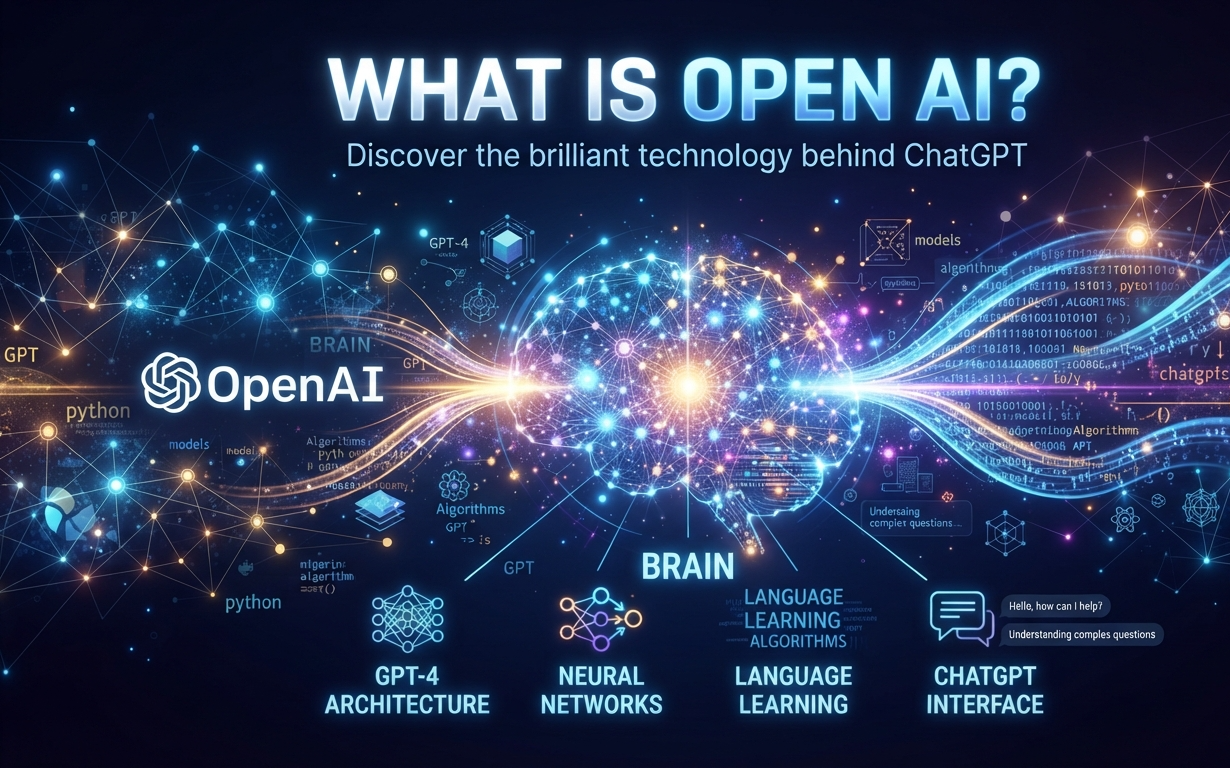
OpenAI is an artificial intelligence research organization and commercial vendor responsible for developing advanced generative AI technologies, including ChatGPT, the GPT model family, and speech recognition tools like Whisper. Founded in 2015 as a non-profit laboratory dedicated to ensuring Artificial General Intelligence (AGI) benefits humanity, OpenAI evolved into a capped-profit enterprise that powers enterprise platforms, developer APIs, and consumer applications worldwide. Through deep learning innovations—specifically the Transformer architecture and Reinforcement Learning from Human Feedback (RLHF)—OpenAI has shaped how businesses and individuals interact with artificial intelligence.
What Is OpenAI? Definition & Mission
OpenAI is an artificial intelligence laboratory and company dedicated to creating safe, capable, and broadly beneficial artificial intelligence systems.The organization develops foundational machine learning models capable of understanding and generating human text, code, audio, and visual media.
At its core, OpenAI’s stated mission is to develop Artificial General Intelligence (AGI)—autonomous systems that outperform humans at most economically valuable tasks—while maintaining strict alignment with human ethics, security, and safety standards.
The Evolution of OpenAI: From Non-Profit to AI Frontier
OpenAI was launched in December 2015 by a group of prominent tech leaders, entrepreneurs, and computer scientists, including Sam Altman, Elon Musk, Greg Brockman, Ilya Sutskever, Wojciech Zaremba, and John Schulman. Initially funded with $1 billion in pledges, it operated strictly as a non-profit research institution committed to publishing open research.
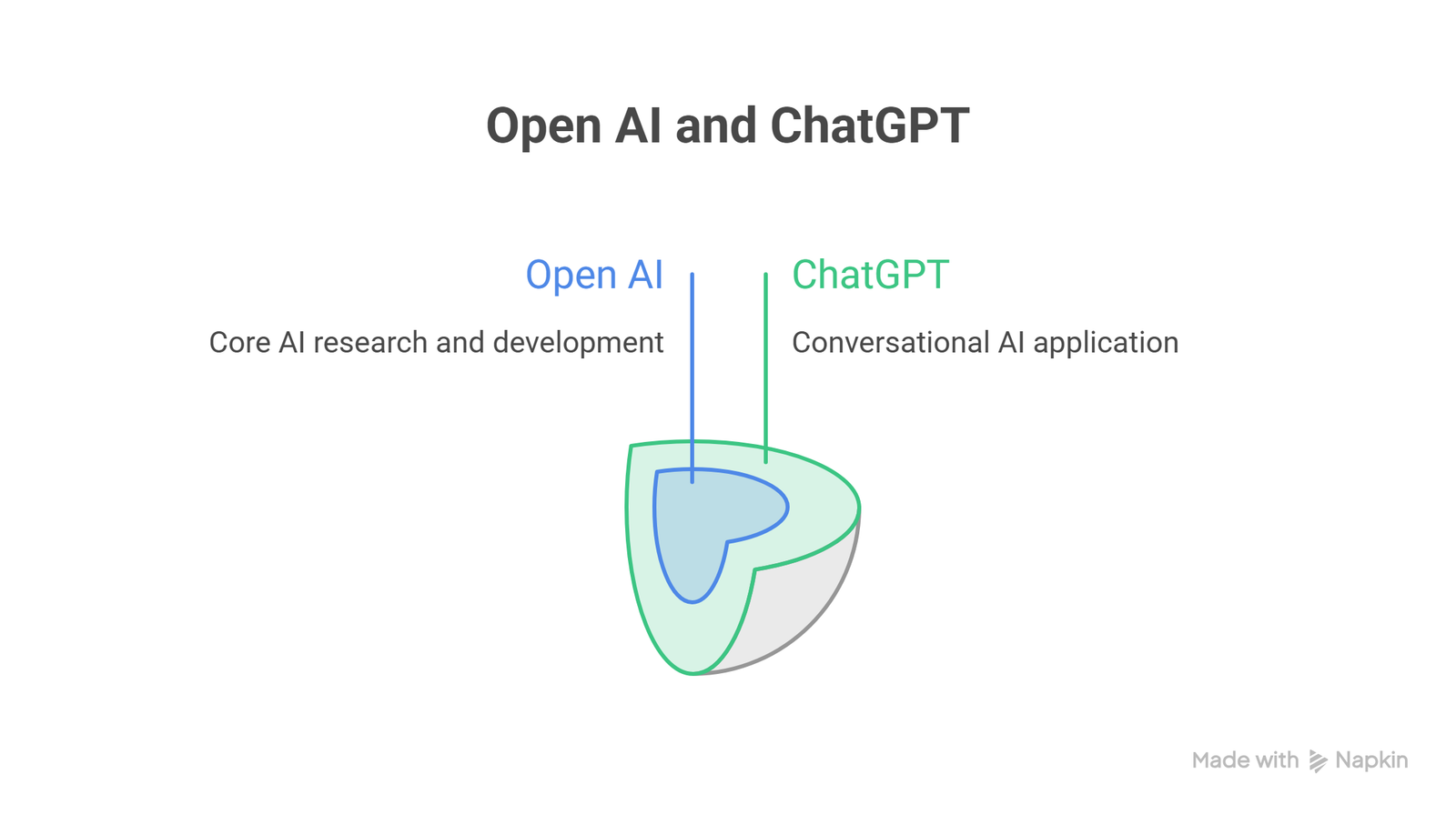
Open-AI-and-Chatgpt
Key Milestones in OpenAI’s Development
2015–2018: Early Research & Gym Releases: Early efforts focused on reinforcement learning environments (OpenAI Gym) and robotic dexterity research.
2018–2019: The GPT Breakthrough & Restructuring: OpenAI introduced the first Generative Pre-trained Transformer (GPT-1) and subsequently GPT-2. To raise the massive capital required for supercomputing clusters, OpenAI transitioned to a “capped-profit” model (OpenAI LP), securing a major strategic partnership and multi-billion-dollar investments from Microsoft.
2020–2022: Scaled Models & Public Launch: The release of GPT-3 gave developers commercial text-generation APIs. In November 2022, OpenAI launched ChatGPT, which became the fastest-growing consumer application in history and brought generative AI into mainstream adoption.
2023–Present: Multimodal Intelligence & Reasoning:Launch of GPT-4, native vision capabilities, custom GPT agents, advanced reasoning models (o-series), and high-performance flagship architectures (GPT-5 series and GPT-6 Astra).https://apkcad.com/generative-ai-vs-ai-automation/
How OpenAI Technology Works
OpenAI builds its core models on deep neural networks trained on massive datasets using supercomputers powered by specialized AI accelerators.
1. The Transformer Architecture
OpenAI’s foundational text models use the Transformer neural network architecture. Transformers process whole sequences of text simultaneously using self-attention mechanisms, allowing the model to determine context and relationships between words over long distances.
During pre-training, models analyze trillions of tokens of text. The primary objective is next-token prediction: calculating the probability distribution of the next word or symbol given the preceding context. Through this process, the model learns grammar, factual knowledge, reasoning patterns, and coding logic.
3. Fine-Tuning & RLHF (Reinforcement Learning from Human Feedback)
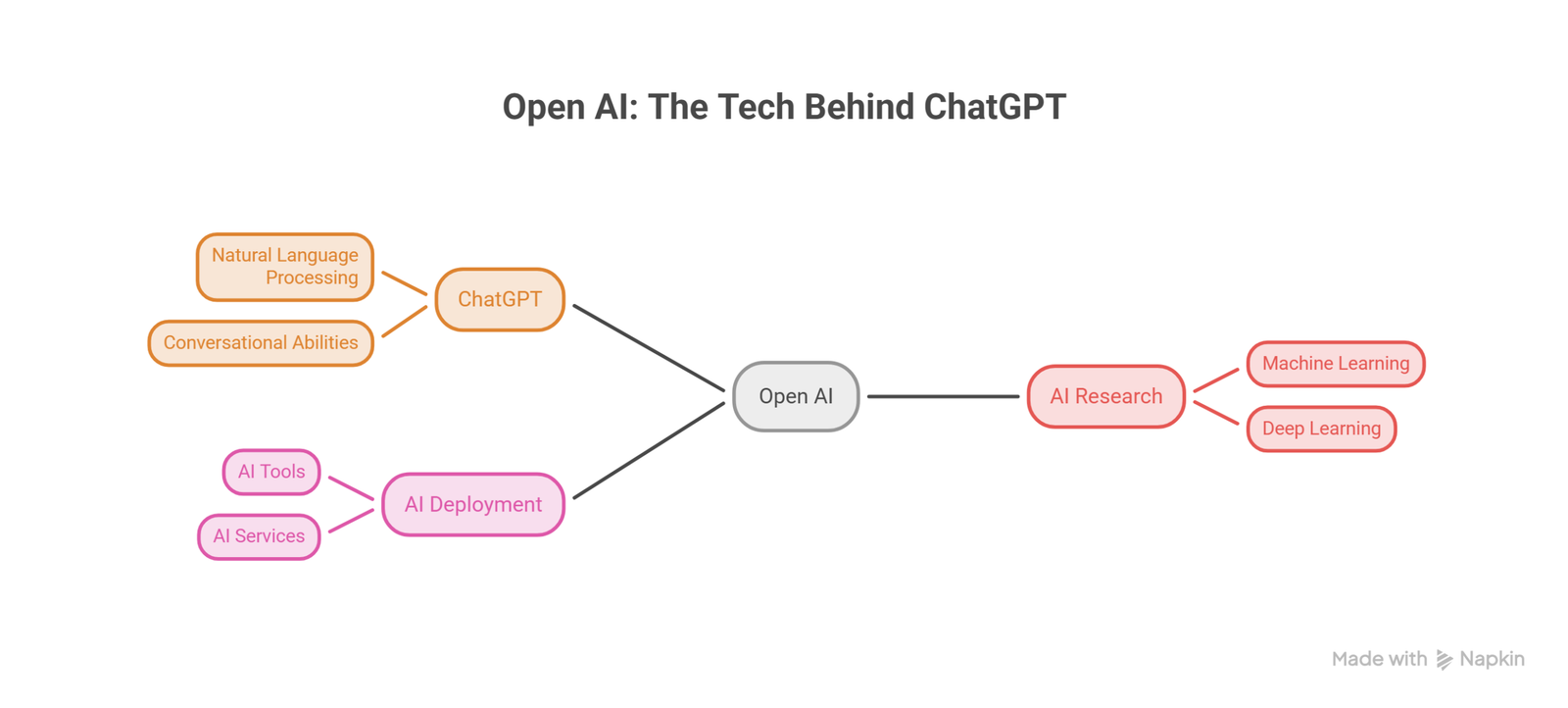
Raw language models can generate unfiltered or unhelpful text. To make models helpful, honest, and harmless, OpenAI applies instruction fine-tuning and Reinforcement Learning from Human Feedback (RLHF). Human evaluators rank model responses, creating a reward model that trains the AI to align with user expectations and safety guidelines.Open-AI The-tech-behind-chatgpt
Core Models & Product Ecosystem
OpenAI offers tools through two main distribution channels: direct consumer interfaces (such as ChatGPT) and developer interfaces (the OpenAI API).
Overview of Current OpenAI Capabilities
Category
Product / Model Family
Primary Capability
Key Use Case
Conversational Interface
ChatGPT (Free, Plus, Team, Enterprise)
Conversational AI assistant with file analysis and web integration
Daily productivity, research, writing, data analysis
Flagship LLMs
GPT-6 Astra / GPT-5 Series
High-capacity multimodal language & reasoning models
Deep understanding of code syntax, refactoring, and debugging
Automated software engineering, code completion
Speech & Audio
Whisper & GPT-Live Audio
High-accuracy speech recognition, translation, and real-time voice
Transcription, voice agents, accessibility tools
Image Generation
GPT Image / ChatGPT Images
Natural language to high-resolution visual generation
Graphic design, visual prototyping, media creation
Primary Use Cases & Industry Applications
Organizations across sectors deploy OpenAI tools to automate workflows, analyze complex datasets, and create interactive applications.
Software Engineering & Development: Engineers use OpenAI models to write code, build unit tests, explain legacy systems, and debug complex stack traces.
Enterprise Operations & Knowledge Management: Companies connect internal databases to OpenAI APIs to build custom knowledge assistants, document summarizers, and customer support bots.
Content Generation & Marketing: Teams utilize generative tools for draft generation, multi-language localization, SEO planning, and copy editing.
Healthcare & Life Sciences Research:Researchers leverage advanced reasoning capabilities for biomedical analysis, clinical documentation assistance, and literature review synthesis.
Education & Scientific Computing: Students and researchers utilize step-by-step explanations for complex mathematics, physics problem-solving, and language tutoring.
AI Safety, Ethics, and Governance
As AI capabilities expand, OpenAI conducts safety research and implements governance measures to mitigate potential societal risks.
Alignment Research: Aligning model behavior with intended human values to prevent unexpected actions.
Red Teaming & Stress Testing:Engaging external safety experts to deliberately test models for vulnerabilities, prompt injection, or misuse before public launch.
Data Privacy & Governance: Enterprise tiers provide strict data protection guarantees, ensuring user inputs are not used for public model retraining.
Hallucination Reduction: Utilizing search retrieval, grounded context, and inference-time reasoning to lower factual error rates.
OpenAI vs. Major Industry Competitors
The generative AI market features several leading platforms, each with specific architectural and ecosystem advantages.
OpenAI is the research organization and tech enterprise that builds AI models.ChatGPT is a software product developed by OpenAI—a user-facing chatbot powered by OpenAI’s underlying language models.
How can developers access OpenAI tools?
Developers access OpenAI technologies by signing up for the OpenAI API platform.Through the API, developers can integrate text generation, visual generation, speech-to-text, and custom fine-tuning directly into their own applications.
Is OpenAI a non-profit or a commercial company?
OpenAI operates under a hybrid structure. It was originally founded as a non-profit in 2015. In 2019, it created a capped-profit subsidiary (OpenAI LP) to raise capital for large-scale hardware and training requirements while remaining governed by the non-profit board’s mission.
Are user interactions with OpenAI models kept private?
For paid business and enterprise accounts (such as ChatGPT Enterprise or API usage), OpenAI does not use submitted data to train its models by default. Free consumer versions of ChatGPT may use conversation logs for model improvements unless users explicitly opt out through privacy settings.
Conclusion
OpenAI stands as one of the central figures in modern computing, driving the rapid evolution of artificial intelligence from theoretical research into accessible tools. Through systematic advancements in neural network architecture, reinforcement learning, and product execution, OpenAI has changed how software is developed, business workflows are structured, and information is accessed. As model capabilities expand toward higher reasoning capacity and autonomous task execution, OpenAI continues to shape the standards and safety frameworks that govern the future of artificial general intelligence.