The integration of Generative Artificial Intelligence (GenAI) across K-12 and higher education in the United States has evolved rapidly. Early knee-jerk bans on platforms like ChatGPT have largely given way to structured, framework-driven implementation. Across American school districts and university campuses, educators and administrators are pivoting toward proactive guidance, clear governance, and curriculum modernization.
This article explores the concrete steps U.S. educational institutions are taking to regulate, adopt, and teach artificial intelligence responsibly.
Quick Summary
U.S. schools have transitioned from initial technology bans toward structured integration of artificial intelligence. Guided by state-level frameworks, school districts are deploying Acceptable Use Policies (AUPs), redesigning assessments to prevent cognitive offloading, and introducing student AI literacy. Rather than relying solely on detection software, educators are moving toward process-based evaluations and leveraging AI to streamline lesson planning and administrative workflows.
Table of Contents
- State Guidelines and Policy Frameworks
- Shift in Classroom Assessments and Grading
- AI Literacy and K-12 Curriculum Integration
- Teacher Workload Reduction and Administrative Tools
- Data Privacy and Equity Considerations
- Frequently Asked Questions (FAQs)
- Conclusion
1. State Guidelines and Policy Frameworks
Education governance in the United States is decentralized, meaning state departments of education and local school boards set individual policies. Dozens of states—including California, Florida, Utah, Georgia, and North Carolina—have published official AI guidance frameworks for public school districts.
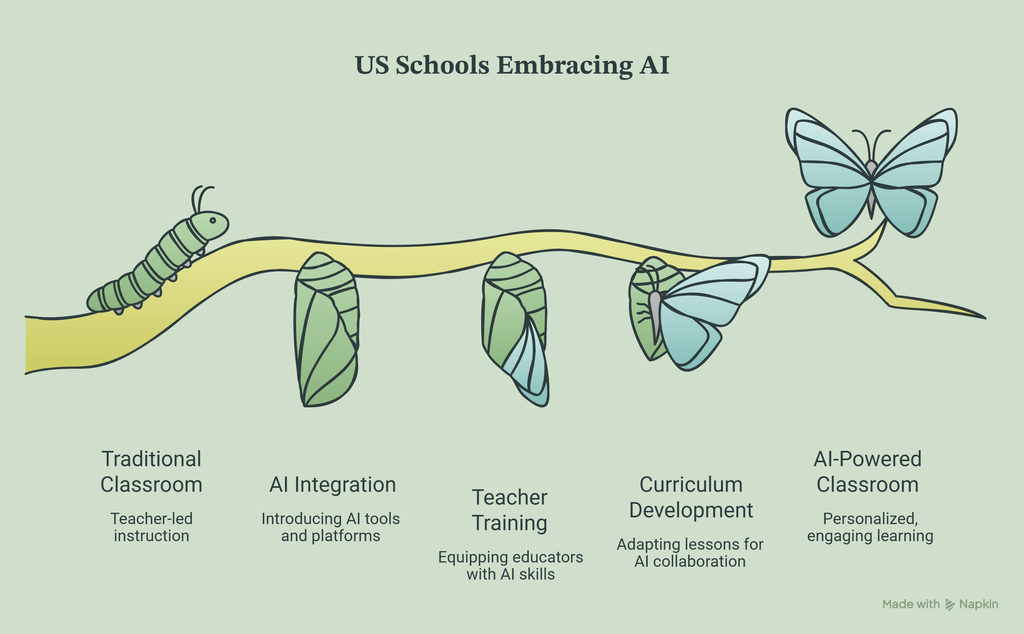
Key administrative strategies include:
- Traffic Light Frameworks: Many districts use a tri-color system (Red, Yellow, Green) on course syllabi to inform students when AI tools are prohibited, allowed with citations, or explicitly required for an assignment.
- Human-in-the-Loop Directives: Federal guidelines from the U.S. Department of Education emphasize that AI should assist human decision-making rather than replace teacher judgment in high-stakes areas like grading or individualized education programs (IEPs).
- Acceptable Use Policies (AUPs): Updated student handbooks clearly define academic integrity as it relates to generative models, specifying where assistance ends and plagiarism begins.
2. Shift in Classroom Assessments and Grading
Relying on automated AI detection software has proven problematic for many schools due to high rates of false positives, particularly among English Language Learners (ELLs). Consequently, American educators are rethinking how student work is evaluated.
To preserve academic integrity without relying on flawed detectors, schools are adopting several practical approaches:
- Process-Oriented Grading: Teachers grade the evolution of a project—including rough drafts, edit histories, and student self-reflections—rather than judging only the final deliverable.
- In-Class and Oral Evaluations: High schools and universities have increased the use of handwritten blue-book exams, live Socratic seminars, and verbal project defenses.
- Authentic Assessment Design: Assignments focus on local community problems, personal experiences, or multi-modal presentations that require human context beyond what standard large language models can generate.
3. AI Literacy and K-12 Curriculum Integration
Instead of treating technology solely as a risk, U.S. schools are introducing AI literacy standards to prepare students for an AI-driven workforce.
- Prompt Engineering and Evaluation: Students learn how to structure clear prompts, analyze AI responses for factual hallucinations, and verify outputs against primary sources.
- Ethics and Algorithmic Bias: High school computer science and social studies classes cover how training data can perpetuate societal biases, data privacy concepts, and intellectual property rights.
- Grade-Band Implementation: Elementary schools focus on basic computational thinking and digital safety, while middle and high schools introduce practical tools for research, coding, and media analysis.
4. Teacher Workload Reduction and Administrative Tools
Teacher burnout remains a significant challenge across the U.S. public school system. Many districts actively train staff on using AI tools to streamline day-to-day operations.
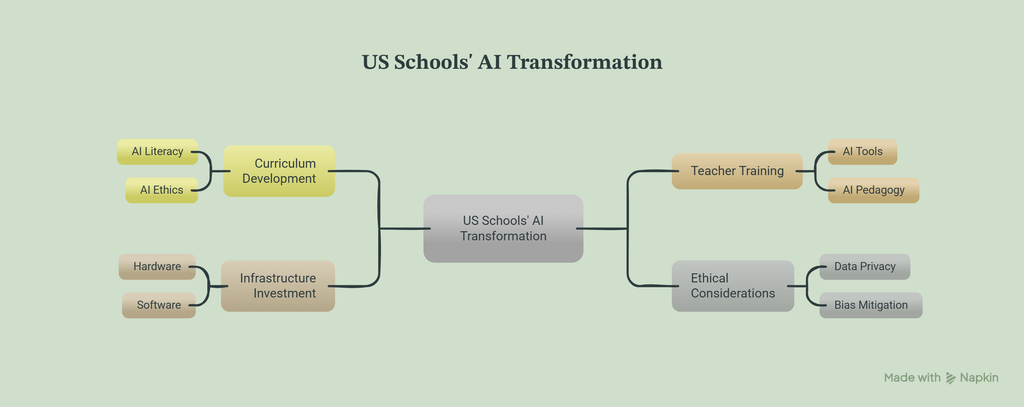
By leveraging AI assistants for lesson planning and administrative support, educators report saving hours of preparation time each week, allowing more direct interaction with students.
5. Data Privacy and Equity Considerations
As districts adopt new software, two major issues dominate school board conversations: student data privacy and digital equity.
- FERPA and COPPA Compliance: Schools must ensure that any vendor providing AI services complies with the Family Educational Rights and Privacy Act (FERPA) and Children’s Online Privacy Protection Act (COPPA). Inputting personally identifiable information (PII) into public AI models is strictly restricted.
- Bridging the AI Divide: Disparities exist between well-funded school districts that can afford enterprise-grade, privacy-compliant AI subscriptions and underfunded districts relying on free, ad-supported tools. State education agencies are working to provide district-wide enterprise access to level the playing field.
Frequently Asked Questions (FAQs)
Are U.S. public schools banning ChatGPT and AI tools?
No. While some districts initially banned generative tools, the majority of U.S. public schools have shifted to Acceptable Use Policies (AUPs) that allow structured, age-appropriate AI use.
How do schools check if a student used AI on an assignment?
Many districts are moving away from dedicated AI detectors due to accuracy concerns. Instead, teachers use process-based tracking (like revision histories), oral follow-up questions, and in-class writing tasks to verify authentic student work.
What is the official U.S. Department of Education stance on AI?
The U.S. Department of Education advocates for a “human-in-the-loop” model. This principle states that AI should support teachers and students, but human educators must retain ultimate responsibility for instruction, assessment, and administrative decisions.
How are schools teaching students about AI safety?
Schools integrate AI literacy into digital citizenship programs. Students learn to protect their personal privacy, evaluate AI outputs for bias and errors, and recognize the ethical boundaries of automated technology.
Conclusion
The response of U.S. schools to artificial intelligence reflects a pragmatic shift from fear to structured management. By introducing state-level guidelines, updating academic integrity standards, shifting toward process-based grading, and prioritizing student data privacy, American educators are establishing a balanced foundation. As AI capabilities continue to evolve, the primary goal for U.S. educational institutions remains clear: utilizing technology to support human instruction while preparing students with the skills required for an automated future.
Best AI Tools for Students in 2026Best AI Tools for Students in 2026